Teen Patti Guide - Rules, Rankings, Strategy
Teen Patti (meaning "three cards" in Hindi) is India's most beloved card game and the undisputed king of Indian casino entertainment. Often described as the Indian version of three-card poker, Teen Patti has been played across India for generations during festivals like Diwali, family gatherings, and social events. Today, it has evolved into one of the most popular online casino games, available with live dealers on platforms like CricBet99.
This guide is the most comprehensive Teen Patti resource available online. We cover everything from basic rules to advanced strategies, including complete hand rankings with mathematical probabilities, all 11 popular variations with rules and strategy tips for each, advanced techniques for blind play, bluffing, pot control, bankroll management, and opponent reading, plus three detailed case studies with round-by-round analysis. Whether you have never played a hand or you are an experienced player looking to sharpen your edge, this guide provides actionable insights you can use immediately.

What is Teen Patti?
Teen Patti (also spelled Teen Pathi, known as "3 Patti," "Flash," or "Flush" in different regions) is a gambling card game played with a standard 52-card deck without jokers. The game accommodates 3 to 7 players, though 4 to 6 is considered the ideal number for balanced gameplay. Each player receives three face-down cards, and the objective is to have the best three-card hand at the table, or to convince other players that you do through strategic betting and bluffing.
What makes Teen Patti unique among card games worldwide is the blind/seen dynamic. Players can choose to bet without looking at their cards (playing "blind") or after looking at them (playing "seen"). Blind players bet at half the rate of seen players, creating a fascinating layer of strategy that does not exist in Western card games like poker or blackjack. The decision of when to look at your cards, and what to read into other players' decisions to look or stay blind, adds a psychological dimension that makes every hand unique.
Unlike poker, where the best hand is determined by five cards and multiple betting rounds follow community card reveals, Teen Patti uses only three cards with no community cards. This makes the game faster paced and more accessible to beginners while still rewarding experienced players who understand probability, betting patterns, and human psychology. A typical hand of Teen Patti takes 2 to 5 minutes, compared to 5 to 10 minutes for a poker hand.
Teen Patti shares DNA with the British card game Three Card Brag and has structural similarities to poker, but its hand rankings (notably A-2-3 as the highest sequence), betting structure (blind vs seen), and deeply rooted cultural traditions make it a distinctly Indian game. The simplicity of three cards combined with the depth of social play has kept Teen Patti relevant for centuries and fuelled its successful transition to online platforms.
To understand Teen Patti's unique appeal, it helps to compare it directly with its closest Western relative, poker:
| Feature | Teen Patti | Texas Holdem Poker |
|---|---|---|
| Cards per player | 3 (face down only) | 2 hole + 5 community |
| Community cards | None (except in Potblind variant) | 5 cards shared by all |
| Blind/Seen mechanic | Yes (unique to Teen Patti) | No equivalent |
| Highest sequence | A-2-3 | A-K-Q-J-10 |
| Sideshow available | Yes (private card comparison) | No equivalent |
| Hand speed | 2-5 minutes per hand | 5-10 minutes per hand |
| Skill ceiling | Moderate (betting + psychology) | Very high (math + multi-street play) |
| Luck factor | High (only 3 cards, no draws) | Moderate (5 community cards reduce variance) |
| Cultural origin | India (adapted from British Brag) | United States (Texas, 1900s) |
| Popular variations | 50+ (Muflis, AK47, Joker, 999) | 10+ (Omaha, Stud, Razz) |
The game can be played purely for entertainment with matchsticks or chips, or for real money in home games, clubs, and online platforms. On CricBet99, Teen Patti is available with live dealers streaming from professional studios, offering an authentic gaming experience from anywhere in India.
History and Cultural Significance
The exact origins of Teen Patti are debated by historians, but the game has been part of Indian culture for at least 200 years. Most historians trace its roots to the British colonial era when Three Card Brag was brought to India by British officers in the 18th and 19th centuries. Over generations, Indian players adapted the game with local rules (such as the A-2-3 highest sequence rule), Hindi terminology (boot, chaal, pack), and regional variations that transformed it into something entirely its own.
Culturally, Teen Patti holds an especially important place during Diwali, the Hindu festival of lights. According to popular tradition, the goddess Parvati played a dice game with Lord Shiva on Diwali night, and this mythological story evolved into the widespread practice of playing cards during the festival. Teen Patti became the game of choice for millions of Indian families during Diwali celebrations, with even people who never gamble at other times participating in friendly card sessions.
Bollywood has further cemented Teen Patti in Indian popular culture. The 2010 film "Teen Patti" starring Amitabh Bachchan explored the mathematical and psychological aspects of the game. Card playing scenes appear regularly in Hindi cinema, introducing the game to younger generations. The digital revolution starting around 2012 brought Teen Patti to mobile phones, and today millions of Indians play daily on platforms like CricBet99.
The cultural impact of Teen Patti extends beyond entertainment into everyday Indian life. The game has influenced vocabulary (terms like "blind" and "seen" are used metaphorically in Hindi conversations to describe decisions made with or without information), social dynamics (the ability to "read" people at a Teen Patti table is considered a genuine social skill), and even business negotiation (knowing when to fold, when to bluff, and when to go all-in are referenced in Indian corporate contexts). Regional variations of the game reflect India's linguistic and cultural diversity, with different states having their own preferred rules, terminology, and betting customs.
The transition from physical to digital Teen Patti has been one of the most successful game adaptations in Indian mobile gaming history. By 2018, Teen Patti apps had been downloaded over 500 million times across India, making it one of the most-played mobile card games in the world. Today, live dealer Teen Patti on platforms like CricBet99 combines the social experience of sitting at a real table with the convenience of playing from anywhere. Professional dealers stream from purpose-built studios, using real physical cards that players can see being shuffled, cut, and dealt in real-time, replicating the authentic experience that made the game beloved in the first place.

Complete Teen Patti Rules
Game Setup and Boot
Before the first card is dealt, players agree on the boot (ante) - the minimum stake each player puts into the pot before receiving cards. This creates the initial pot and ensures every hand has something to play for. In home games, the boot is typically a small amount. In online games, the boot is determined by the table limit you choose. Some games also set a maximum bet limit to prevent any single player from overwhelming others.
Dealing Cards
The dealer distributes cards one at a time, face down, starting from the player to their left and going clockwise. Each player receives exactly three cards in three rounds (one card per round). After dealing, players must not show their cards to anyone. Looking at your own cards is optional and carries strategic implications.
Blind vs Seen Play
This is what separates Teen Patti from most other card games. After cards are dealt, each player chooses whether to play blind (without looking) or seen (after looking):
| Aspect | Blind Player | Seen Player |
|---|---|---|
| Cards | Has NOT looked at cards | HAS looked at cards |
| Minimum bet | Equal to current stake | Double the current stake |
| Maximum bet | Double the current stake | Four times the current stake |
| Can request sideshow? | No | Yes (with another seen player) |
| Can request show? | No (unless 2 remain) | Yes (when 2 remain) |
| Strategic advantage | Cheaper per round, creates pressure | More information, better decisions |
A blind player can choose to look at their cards at any point, becoming a seen player permanently for that hand. Once you look, you cannot go back to blind.
Playing blind for the first 2 to 3 rounds is almost always correct. It costs half as much per round, puts psychological pressure on seen players who must pay more, and if others fold while you are blind, you win the pot without needing strong cards. The savings from blind play compound over a session.
Betting Rounds
The player to the left of the dealer acts first. Play proceeds clockwise. Each turn, a player can: Call (Chaal) - match the current stake; Raise - increase the bet (blind: up to 2x stake, seen: up to 4x stake); or Fold (Pack) - surrender cards and leave. The raised amount becomes the new current stake. Betting continues until only one player remains (wins pot) or a showdown between the last two.
Sideshow (Compromise)
A seen player can request a sideshow with the previous seen player. The sideshow is one of the most strategically rich elements of Teen Patti, and understanding its mechanics and implications is essential for intermediate and advanced play.
Sideshow mechanics step by step:
- Only a seen player can request a sideshow. Blind players cannot request or be asked for sideshows.
- The request can only be made to the player who bet immediately before you (the previous bettor), and that player must also be seen.
- The previous player can accept or refuse the sideshow request.
- If accepted: Both players privately compare their three cards without showing the rest of the table. The player with the weaker hand must fold. If both hands are exactly equal in rank, the player who requested the sideshow must fold.
- If refused: Play continues normally. The requesting player must call, raise, or fold on their turn. They cannot request another sideshow with the same player on the same turn.
When to request a sideshow: Request sideshows when you have a medium-strength hand (a pair or a low sequence) and want to eliminate one opponent without risking a full showdown where a stronger hand might appear. Sideshows are most valuable when three or more players remain, because they thin the field in your favour.
When to accept a sideshow: Accept when you are confident your hand beats the requester's likely range. Since requesting a sideshow signals medium confidence (truly strong hands prefer to build the pot, truly weak hands prefer to fold), you can estimate the requester's hand is probably a moderate pair or a weak sequence.
When to refuse a sideshow: Refuse when you want to keep all opponents in the hand (perhaps you are building the pot with a strong hand) or when you suspect the requester might be trying to eliminate you specifically because they read your hand as the biggest threat.
Showdown
When two players remain, either can request a show. Both reveal cards and the higher hand wins. A blind player cannot request a show (must look first). If a seen player shows against a blind player, the seen player pays double the current blind stake. If both hands are identical, the player who did NOT request the show wins.
Teen Patti Hand Rankings
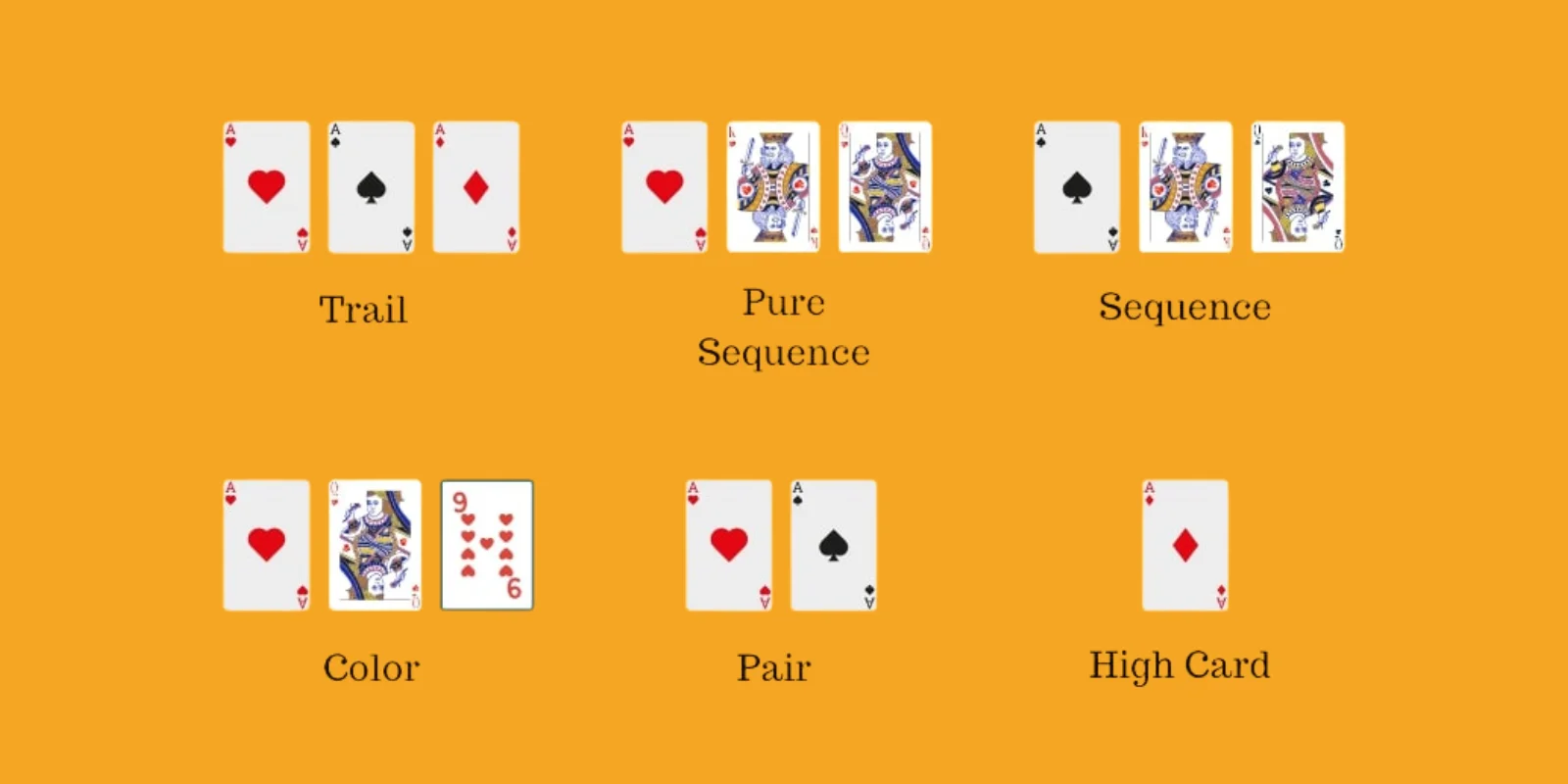
Complete Rankings Table
| Rank | Hand | Also Called | Description | Example |
|---|---|---|---|---|
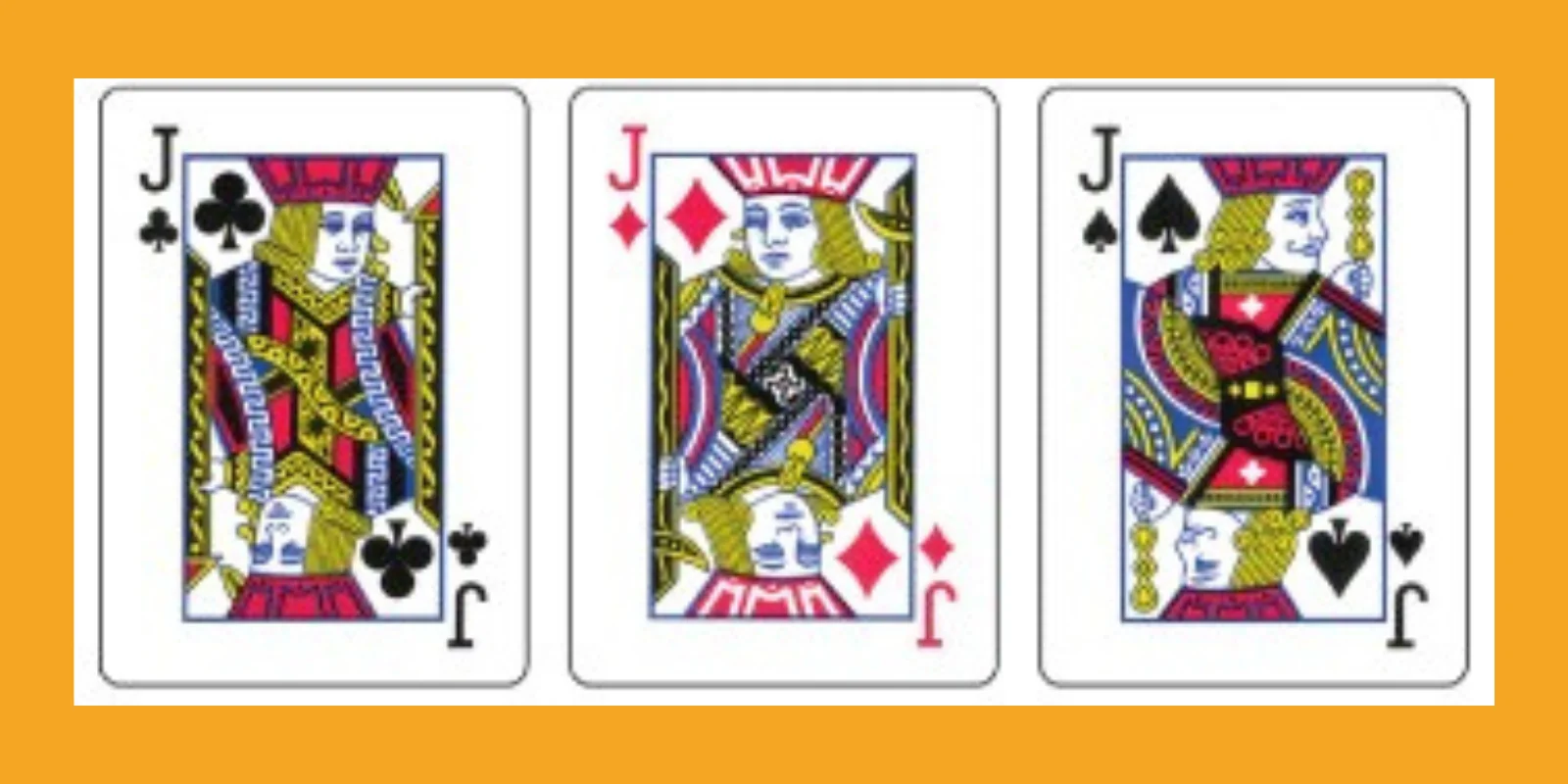
| 1 | Trail | Set, Trio | Three cards of same rank | A-A-A, K-K-K, 7-7-7 |
| 2 | Pure Sequence | Straight Flush | Three consecutive, same suit | A-2-3 of hearts |
| 3 | Sequence | Straight, Run | Three consecutive, mixed suits | 5-6-7 mixed |
| 4 | Color | Flush | Same suit, not consecutive | 2-7-K all diamonds |
| 5 | Pair | Double | Two same rank + one different | A-A-5, J-J-3 |
| 6 | High Card | Nothing | Three unmatched cards | A-8-3 mixed |
Probability of Each Hand
With a 52-card deck and 3-card hands, there are exactly 22,100 possible combinations. Understanding these probabilities helps you assess relative hand strength and make better betting decisions:
| Hand | Combinations | Probability | Odds Against | Frequency |
|---|---|---|---|---|
| Trail | 52 | 0.24% | 424 to 1 | 1 in 425 hands |
| Pure Sequence | 48 | 0.22% | 459 to 1 | 1 in 460 hands |
| Sequence | 720 | 3.26% | 29.7 to 1 | 1 in 31 hands |
| Color | 1,096 | 4.96% | 19.2 to 1 | 1 in 20 hands |
| Pair | 3,744 | 16.94% | 4.9 to 1 | 1 in 6 hands |
| High Card | 16,440 | 74.39% | 0.34 to 1 | 3 of 4 hands |
Nearly 75% of all Teen Patti hands are high card (no pair, no sequence, no flush, no trail). Only 1 in 4 hands will have a pair or better. A trail appears roughly once every 425 hands. This means that in most rounds, nobody at the table has a particularly strong hand, which is exactly why bluffing and blind play are such important parts of the game. If you only play when you have a strong hand, you will fold 75% of the time and lose money slowly through boot contributions.
Special Ranking Rules
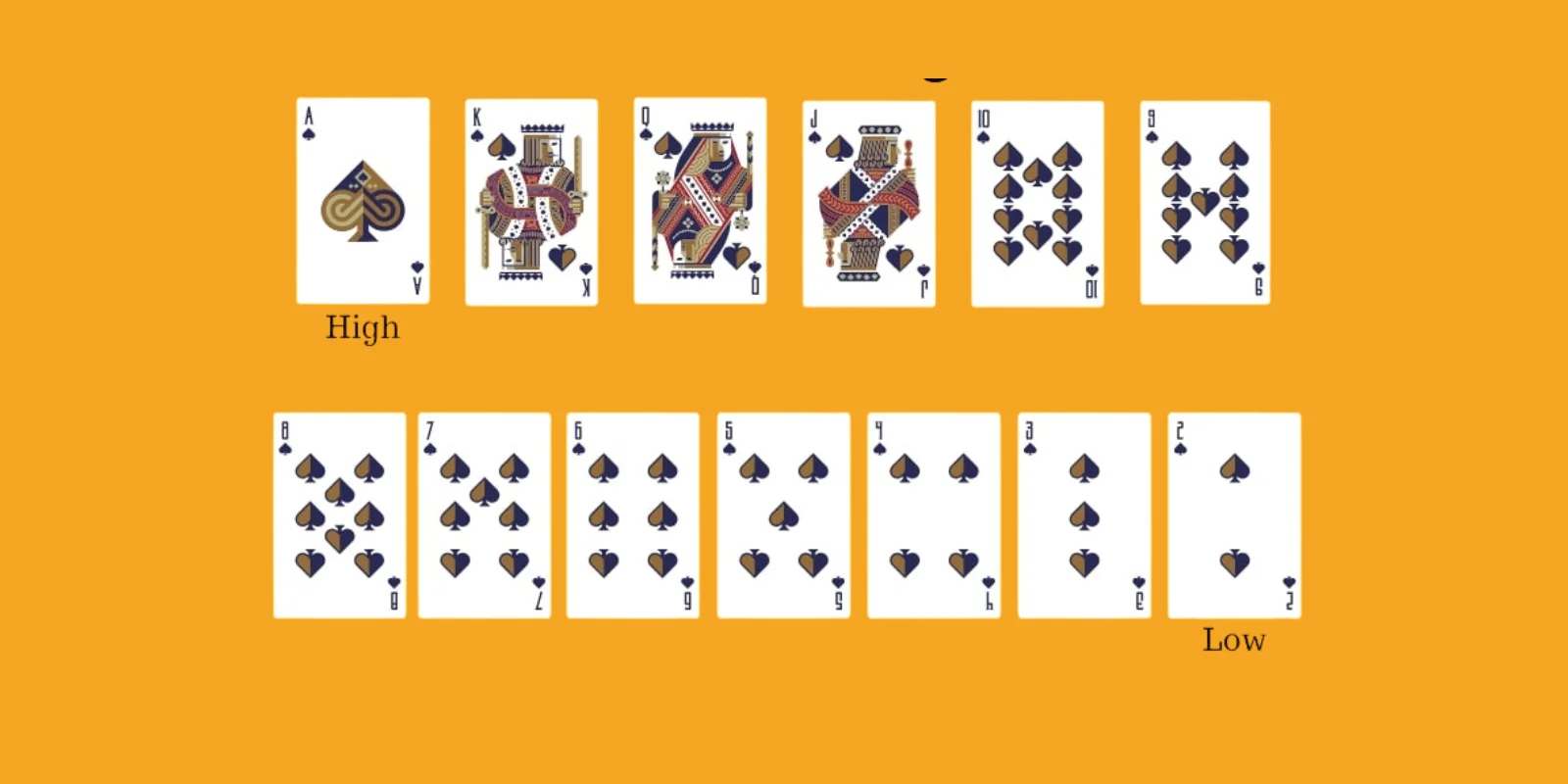
- A-2-3 is the HIGHEST sequence - not A-K-Q. This is the single most important rule difference from poker. The sequence order is: A-2-3 > A-K-Q > K-Q-J > Q-J-10 and down to 4-3-2.
- Between two trails: Higher rank wins. A-A-A beats K-K-K. 2-2-2 is the lowest trail.
- Between two pairs: Higher pair wins. If pairs are equal, compare the kicker. A-A-K beats A-A-Q.
- Between two colors/flushes: Compare cards highest to lowest. A-K-5 beats A-Q-J.
- Suits are NOT ranked. If two hands have identical card ranks in different suits, they are considered equal.
Example Hand Walkthrough
Scenario
4 players: Arun (dealer), Priya, Raj, Sonia. Boot: 100 rupees each. Starting pot: 400 rupees.
Round 1: Priya plays blind, bets 100 (the minimum blind bet). Raj looks at his cards and sees J-J-5 (pair of Jacks). As a seen player, he bets 200 (the seen minimum). Sonia plays blind, bets 100. Arun looks at his cards and discovers 7-8-9 of clubs (a pure sequence, the second-highest hand type). He raises to 400. Current pot: 400 + 100 + 200 + 100 + 400 = 1,200.
Round 2: New stake is 200 (half of Arun's 400, for blind players). Priya continues blind, bets 200. Raj calls at 400 (the seen rate). Sonia decides to look at her cards. She has A-8-3 mixed suits (high card only). Seeing the aggressive betting, she wisely folds, losing her 200 invested. Three players remain. Pot: 2,000.
Round 3: Priya finally looks at her cards. She has A-2-3 of mixed suits (a sequence, and the highest possible sequence in Teen Patti). She raises to 600. Raj, holding his pair of Jacks, is uncertain. He requests a sideshow with Arun (the previous seen player). Arun accepts. They privately compare: Raj's J-J-5 pair loses to Arun's 7-8-9 pure sequence. Raj must fold.
Two players remain: Priya and Arun. Priya requests a show. Both reveal cards. Priya: A-2-3 sequence. Arun: 7-8-9 pure sequence. Arun wins because pure sequence (same suit) outranks regular sequence (mixed suits), regardless of the card values involved.
Priya had the highest possible sequence (A-2-3) but lost because Arun had a pure sequence, which ranks one tier higher. Hand TYPE always matters more than card VALUES within the hierarchy. A 2-3-4 pure sequence beats an A-K-Q regular sequence.
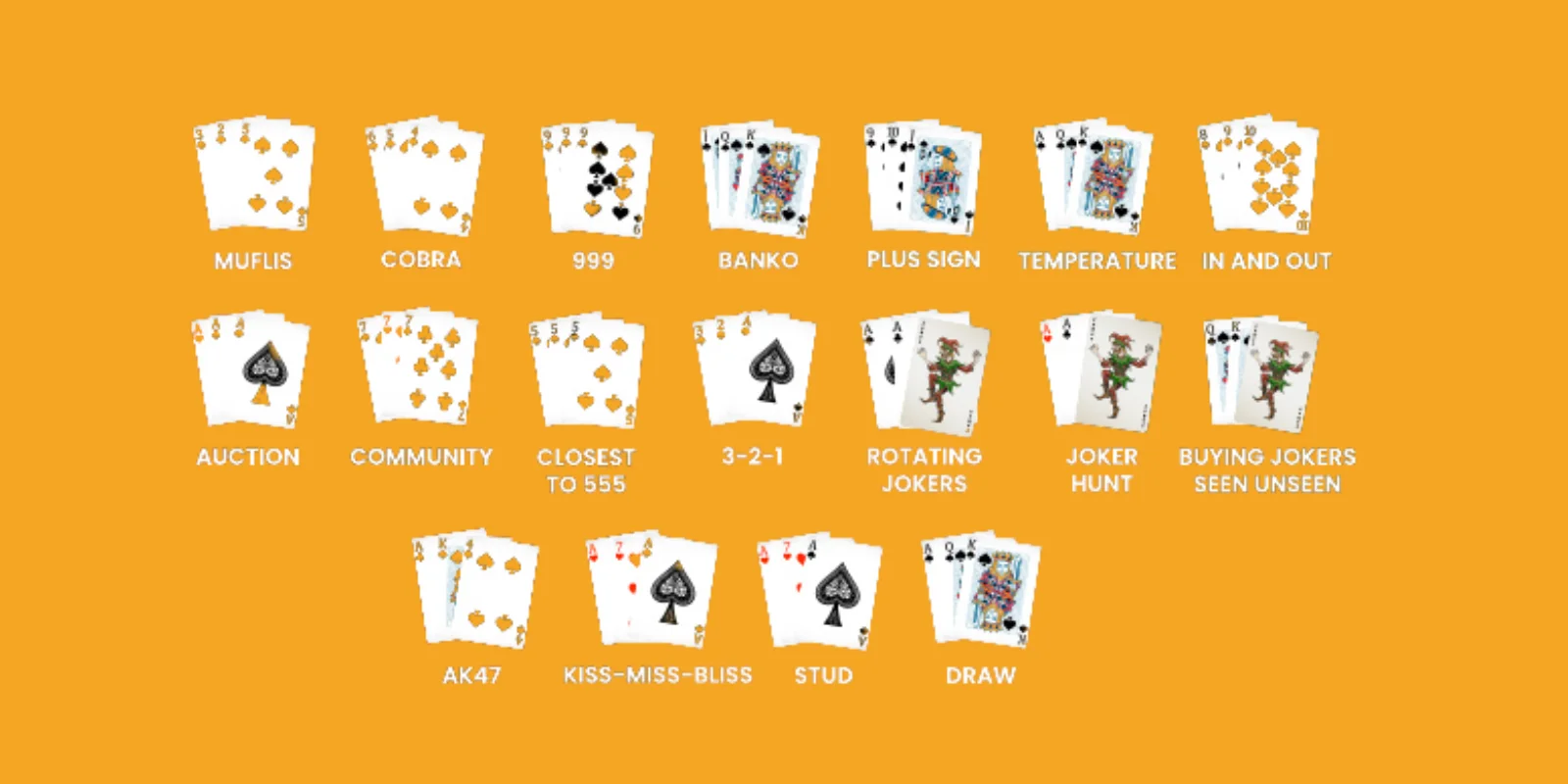
All 11 Popular Teen Patti Variations
One of the reasons Teen Patti has remained popular for centuries is the extraordinary number of variations. Each changes one or more fundamental aspects, from hand rankings to wild cards to dealing mechanics, creating entirely new strategic puzzles.
1. Classic Teen Patti
Standard rules with no wild cards or modifications. The purest test of card-playing skill because your three cards are what they are. About 75% of hands are high card, meaning most pots are won through confident betting rather than card strength. Bluffing frequency is highest in classic because strong hands are rare. Master classic before exploring other versions.
2. Joker (Wild Card)
One or more cards become wild, substituting for any card. Three methods: Random Joker (one rank drawn, all four cards of that rank are wild), Pulled Joker (each player draws a personal joker), or Fixed Joker (pre-agreed wild cards). With four wild cards, approximately 23% of hands include at least one joker, making trails and pure sequences far more common. A pair that wins in classic may be too weak in Joker. Raise your hand evaluation standards significantly.
3. Muflis (Lowball)
Hand rankings are completely reversed. The lowest hand wins. High Card (normally worst) becomes best. Trail (normally best) becomes worst. The ideal Muflis hand is 2-3-5 of mixed suits (lowest possible high card avoiding a sequence). The hardest part is the mental rewiring: when you see A-K-Q, your instinct says "great" but in Muflis it is mediocre. Bluffing dynamics flip too, since players with genuinely "good" (low) Muflis hands bet confidently while high-card holders feel weak.
| Muflis Rank | Hand | Classic Rank |
|---|---|---|
| 1 (Best) | High Card | 6 (Worst) |
| 2 | Pair | 5 |
| 3 | Color | 4 |
| 4 | Sequence | 3 |
| 5 | Pure Sequence | 2 |
| 6 (Worst) | Trail | 1 (Best) |
4. AK47
All Aces, Kings, Fours, and Sevens are wild (16 out of 52 cards). Extremely chaotic. In a 4-player game with 12 cards dealt, the probability of at least one player having a trail exceeds 80%. Pairs and sequences are virtually worthless. Only play aggressively with natural trails or very high wild-assisted trails. If your three cards contain zero wilds, fold immediately since you cannot compete.
5. Best of Four
Four cards dealt, pick the best three-card hand. Pair probability jumps from ~17% to ~30%. Sequences approximately double in frequency. Low pairs (2s through 8s) are often not enough. Look for high pairs (Jacks+), sequences, or better to play aggressively.
6. 999
Hand closest to total value of 9 wins. Aces = 1, face cards = 0, others = face value. If total exceeds 9, take last digit (like Baccarat). Examples: 7-8-4 = 19, value = 9 (perfect). A-3-5 = 9 (perfect). K-Q-J = 0 (worst). Standard rankings do not apply. Limited skill since it is purely about card totals. Play aggressively if your hand totals 7, 8, or 9. Fold at 4 or below.
7. Hukam (Trump Suit)
A trump suit is declared each round. Any trump card beats non-trump cards regardless of rank. Count your trump cards: three trumps = very strong color. Two trumps = flexibility. Zero trumps = disadvantage.
8. Potblind
One community card dealt face-down to the centre. Revealed after betting, before showdown. All players can use it to replace one of their three cards. This discourages early folding (weak hands have a rescue option) and creates larger pots.
9. Kissimiss
Cards one rank above and below the Joker also become wild. If joker is 7, all 6s, 7s, and 8s are wild (12 wild cards total). Halfway between Joker and AK47 in chaos level. Trails are common but not guaranteed.
10. Discard One
Four cards dealt, must physically discard one face-down before play begins. Unlike Best of Four, the discard is permanent. Experienced players consider not just their current best hand but what their discard choice reveals to observant opponents.
11. Banko
Two-player pure luck variant. Neither player looks at cards. Both reveal simultaneously after agreeing on a bet. Higher hand wins. Zero strategy. Used as a quick side bet between regular rounds.
Winning Strategies for Teen Patti
While luck determines which cards you receive, how you play those cards determines your long-term results. These strategies apply to both live and online games.
1. Blind Play Strategy
Play blind for the first 2-3 rounds. This is almost always correct because you invest less (half rate) and create psychological pressure. If weak players fold during your blind play, you win cheaply without needing good cards. Extended blind play (4-5 rounds) is especially powerful when you are among the last players remaining. Seen opponents pay double your rate, creating a cost asymmetry that often forces them to fold or risk a showdown against your unknown hand.
When to look: When the pot has grown large enough that an informed decision matters. When multiple opponents are betting confidently. When only two players remain and you may need to request a show.
In a 5 or 6 player game, staying blind while others look and drop out is highly profitable. By round 3 or 4, if you are one of the last 2 or 3 players and still blind, you have invested very little while the pot has grown through others' seen-rate bets. When you finally look, you either have a hand worth playing or you can attempt one well-timed bluff at minimal total cost.
2. Bankroll Management
Set a session budget before playing and never exceed it. Choose tables where the boot is 1-2% of your budget. This gives you 50 to 100 hands to weather normal variance.
| Session Budget | Recommended Boot | Minimum Hands | Session Length |
|---|---|---|---|
| 2,000 rupees | 20-50 rupees | 40-100 | 30-60 minutes |
| 5,000 rupees | 50-100 rupees | 50-100 | 45-90 minutes |
| 10,000 rupees | 100-200 rupees | 50-100 | 60-120 minutes |
| 25,000 rupees | 200-500 rupees | 50-125 | 90-180 minutes |
Avoid raising to the maximum on every hand. Save large raises for genuinely strong hands. Flat calling with marginal hands keeps the pot manageable and reduces your risk.
3. Reading Opponents
Reading opponents is the most valuable skill in Teen Patti because it allows profitable decisions with any hand. Key patterns to watch:
- Quick look + immediate raise = strong hand. They saw something good and confidence is genuine. Fold weak holdings against this pattern.
- Hesitation before calling = marginal hand. They are considering folding. Apply pressure next round with a confident raise.
- Sudden switch from blind to seen + raise = one of the strongest tells. They were happy playing blind cheaply, looked, found something good, and switched to aggressive play. Respect this pattern.
- Frequent sideshow requests = medium-strength hands (typically pairs or weak sequences). They want to eliminate opponents privately rather than risk a full showdown.
- Extended blind play (5+ rounds) = deliberate strategy, not card-dependent. These players are experienced.
- Online timing tells: Fast actions (1-2 seconds) = automatic play, either very strong or clear fold. Long pauses (8-15 seconds) = genuinely difficult decision. Very long pauses (20+ seconds) often precede a big bluff.
- Bet sizing patterns: Some players unconsciously bet the minimum with weak hands and raise with strong ones. Spot this and read their hand with high accuracy.

4. Pot Control
Pot control means managing pot size relative to hand strength: big pots with big hands, small pots with small hands.
| Hand Strength | Action | Target Pot | Risk |
|---|---|---|---|
| Trail | Build pot aggressively, gradual raises | As large as possible | Very Low |
| Pure Sequence | Build pot, watch for trails | Large | Low |
| Sequence | Moderate raises, pot control | Medium | Medium |
| Color | Call, selective raising | Medium | Medium |
| High Pair (J+) | Call, raise if table is weak | Small-Medium | Medium-High |
| Low Pair | Call small bets only | Small | High |
| High Card | Fold after looking | Minimize | Very High |
5. Bluffing Techniques
Bluffing is essential because 75% of hands are high card. Winning only with strong cards means folding three-quarters of the time and bleeding money through boots.
The blind semi-bluff (best bluff in Teen Patti): Continue betting blind without intending to look. It costs half as much, creates enormous pressure, and you might actually have strong cards. If everyone folds, you win. If one player remains and you must look, you might find a decent hand anyway.
Consistency bluff: A sudden raise after calling for rounds screams "bluff." Instead, bet consistently from the start. If you raise round 1 and continue raising, the pattern matches genuine strong-hand behavior and is harder to distinguish from value betting.
Image-based bluff: If you have been playing tight (folding most hands, showing strong cards at showdowns), use that "tight" image to bluff. Opponents will assume you have strength based on your history.
Target selection: Bluff against cautious players who fold frequently. Never bluff calling stations. Never bluff short-stacked players who are pot-committed. Never bluff when 3+ players remain (too many people to fold). Never bluff when the pot is huge relative to the bet (opponents get good pot odds to call).
Professional Teen Patti players bluff about 20 to 30 percent of the time they bet or raise. This frequency prevents opponents from always folding to your raises (which would make strong hands less profitable) while still showing genuine hands the majority of the time (maintaining credibility). If you bluff more than 30%, opponents will catch on and call you down with marginal hands.
6. Position Awareness
Acting later in the betting round gives a significant advantage. The player to the right of the dealer (last to act) can: fold confidently when earlier players raise aggressively (saving money), raise with marginal hands when everyone calls weakly (exploiting weakness), and steal pots with well-timed bluffs when the table shows passivity. Playing blind from late position is especially powerful because you act last with the cheapest bet.
7. Knowing When to Fold
Folding is the most underrated skill. Many players lose sessions not from poor play with cards but from refusing to fold when they should.
- Fold high-card hands below Queen-high after looking. With J-8-3, you have almost no showdown value.
- Fold low pairs (2s-7s) against aggressive seen players. A pair of 5s is beaten by higher pairs, sequences, colors, and trails.
- Fold when the pot exceeds your comfort level. No single hand is worth busting your bankroll.
- Trust your reads. If your read says the opponent is strong, fold regardless of your hand.
The cost of not folding: In 50 hands, about 37 will be high card. Staying in each for 3 rounds at 200 rupees per round (seen rate) costs 22,200 rupees on losing hands. Folding those 37 hands at the boot (3,700 rupees) saves 18,500 rupees. That saved money funds aggressive play on your 13 stronger hands.
Case Studies and Example Scenarios
Case Study 1: Power of Extended Blind Play
Setup: 5-player game, 100 rupee boot (pot starts at 500).
Round 1: You play blind (100). Two players look and fold. Two seen players call (200 each). Pot: 1,100.
Round 2: You continue blind (100). One seen player calls (200). Other folds. Two remain. Pot: 1,500.
Round 3: You continue blind (100). Opponent calls (200). Pot: 1,800.
Round 4: You look: Q-10-7 mixed (high card). Weak cards. But opponent has only been calling (never raising), suggesting marginal hand. You raise to 400, representing confidence. Opponent thinks for a long time and folds.
Result: You win 1,800 rupees with Queen-high. Total investment: 400 rupees. Blind play created the illusion of hidden strength.
Case Study 2: The Slow-Play Trap
Setup: You look at 9-9-9 (trail). Instead of raising immediately (which would scare everyone), you flat call for two rounds. Others interpret calls as mediocrity. Opponent with K-K-3 (pair of Kings) raises confidently. By round 3, pot is 2,400. You raise for the first time. Opponent calls. Showdown: your 9-9-9 trail beats K-K-3 pair.
Lesson: Slow-playing monster hands lets the pot grow. Immediate raises would have earned you a small win instead of a large one.
Case Study 3: The Costly Bluff Against a Calling Station
Setup: You have 5-8-J mixed (high card). You bet aggressively for 4 rounds against a single opponent who calls every time without raising or showing concern. Total invested: 2,400 rupees. Showdown: opponent reveals A-A-7 (pair of Aces).
Analysis: The opponent was a calling station. They had a strong hand and were happy to let you build the pot. Steady, unflinching calling almost always indicates strength. Never bluff calling stations.

Advanced Concepts for Experienced Players
Once you have mastered the basics of Teen Patti, these advanced concepts will give you an edge over most players at your table. These are the techniques that separate break-even recreational players from consistently profitable ones.
Mathematical Expected Value (EV) in Teen Patti
Every bet you make in Teen Patti has an expected value, which is the average amount you expect to win or lose over many repetitions of the same situation. Understanding EV helps you make objectively better decisions rather than relying on gut instinct.
Simple EV calculation example: You are heads-up (two players remaining). The pot is 2,000 rupees. Your opponent requests a show. You have a pair of Queens. Based on the betting pattern, you estimate your opponent has a 60% chance of having a hand weaker than your pair (high card or lower pair) and a 40% chance of having a hand stronger (higher pair, sequence, color, or trail).
Your EV = (60% chance of winning x 2,000 rupee pot) minus (40% chance of losing x your bet of 400 rupees) = 1,200 minus 160 = +1,040 rupees. Since the EV is positive, calling the show is mathematically correct regardless of whether you win or lose this specific hand. Over hundreds of similar situations, you will profit.
Applying EV thinking to every betting decision transforms Teen Patti from a gambling game into a skill game with a mathematical framework. You stop asking "will I win this hand?" and start asking "is this bet profitable in the long run?"
Table Selection and Game Selection
One of the most overlooked skills in Teen Patti is choosing the right table. Not all tables are equally profitable, and playing at the wrong table can turn even a skilled player into a loser.
Signs of a profitable table:
- Multiple players who look at their cards immediately every hand (they give up blind play advantage)
- Players who rarely fold (calling stations who put too much money in with weak hands)
- Players who are visibly emotional, either celebrating wins loudly or showing frustration after losses (emotional players make poor decisions)
- A mix of tight and loose players rather than a table full of one type (diversity creates exploitable patterns)
Signs of an unprofitable table:
- Multiple players who regularly play blind for extended periods (they understand the strategy)
- Players who fold quickly and rarely show weak hands at showdown (tight, disciplined opponents)
- Players who vary their bet sizes unpredictably (they are using advanced bet sizing to disguise their hands)
- A table where everyone seems to know each other and plays seriously (experienced group with established dynamics)
In online Teen Patti on CricBet99, you can observe a table for a few rounds before sitting down. Use this time to identify player tendencies. In home games, you often do not get to choose your table, but you can choose your seat. Sit to the left of aggressive players (so you act after they reveal their intentions) and to the right of passive players (so you can exploit their weakness before they act).
Session Review and Record Keeping
Professional card players keep records of their sessions, including buy-in amounts, cash-out amounts, hours played, and notable hands. This data reveals patterns that are invisible in the moment: Are you winning more on certain days? At certain stake levels? Against certain player types? Are you losing more in later hours when fatigue sets in?
Online platforms like CricBet99 provide automatic transaction histories, making record keeping easy. Review your results weekly to identify leaks (situations where you consistently lose money) and strengths (situations where you consistently profit). The most common leaks for intermediate Teen Patti players are: over-bluffing (especially against calling stations), staying in hands too long with pairs when facing heavy action, and playing too many hands in the hour before they plan to stop (impatience leading to poor decisions).
Adapting to Different Player Types
Every Teen Patti table has a mix of player archetypes. Identifying and adapting to each type is critical for consistent profits:
| Player Type | Behaviour | How to Exploit |
|---|---|---|
| Calling Station | Calls every bet, rarely folds, rarely raises | Never bluff. Value bet with medium and strong hands. Let them call you down. |
| Rock (Ultra-Tight) | Folds most hands, only plays strong cards | Steal their boot contributions by raising when they fold. Fold when they bet since they always have it. |
| Maniac (Ultra-Aggressive) | Raises constantly, plays every hand, bluffs frequently | Let them bet into your strong hands. Call them down more often since they are often bluffing. |
| TAG (Tight-Aggressive) | Plays few hands but bets aggressively when they play | The toughest opponent. Avoid marginal confrontations. Play position against them. |
| Emotional/Tilted | Playing erratically after a bad beat or loss streak | Play solid fundamentals. They will make mistakes. Be patient and capitalize. |
The key principle: play the opposite style to your opponents. Against passive players, be aggressive. Against aggressive players, be patient and trap them. Against tight players, steal frequently. Against loose players, tighten up and value bet relentlessly. The worst strategy is playing the same way regardless of who you are facing.
Emotional Discipline and Tilt Prevention
Tilt is a state of emotional frustration that leads to poor decisions, and it is the single biggest profit killer in Teen Patti. Common tilt triggers include: losing a big pot with a strong hand to an even stronger one (bad beat), getting bluffed successfully and being shown weak cards, losing several hands in a row even while playing well, and personal life stress bleeding into your card game.
Recognising that you are tilting is the first step. Warning signs include: wanting to bet bigger to "get even," playing more hands than usual, feeling angry at opponents or the game itself, and ignoring your bankroll limits. The correct response to tilt is always the same: stop playing. Take a break of at least 15 minutes (longer if needed). Return only when you feel calm and can make decisions based on logic rather than emotion.
Professional card players treat tilt prevention as a core skill, not a secondary concern. Your emotional state directly affects your decision quality, and decisions are the only thing you control in Teen Patti. The cards are random, the opponents are unpredictable, but your reactions are entirely within your power.
Common Mistakes
- Looking at cards too early - wastes the cost advantage and psychological pressure of blind play. Leave cards face down for at least 2 rounds.
- Playing every hand - the boot is a sunk cost. Fold weak cards and save money for strong opportunities.
- Showing emotions after looking - maintain an identical expression whether you see A-A-A or 2-5-8.
- Over-bluffing - keep bluffs to 20-30% of aggressive actions. More than that destroys credibility.
- Ignoring pot odds - if the pot offers 15:1, calling is usually correct even with weak cards.
- Chasing losses - each hand is independent. Previous losses do not affect future cards. Stick to your budget.
- Not adapting to the table - strategies that work against cautious players fail against loose callers.
- Forgetting the A-2-3 rule - it is the highest sequence. Not A-K-Q. This costs real money at showdown.
- Playing too many variations simultaneously - each variation has different optimal strategies. Focus on one at a time.
- Neglecting bankroll management - the most common reason players quit Teen Patti is running out of money in a single bad session.
Online vs Offline Teen Patti
| Aspect | Offline (Home/Club) | Online (CricBet99) |
|---|---|---|
| Physical tells | Available (expressions, tremors, posture) | Timing tells only |
| Speed | Slower (manual dealing, conversation) | Faster (automatic dealing) |
| Card integrity | Risk of marked cards or cheating | Certified RNG, guaranteed fair |
| Availability | Need to organize players and venue | Available 24/7 with live dealers |
| Variations | Group agreement required | Multiple available simultaneously |
| Social experience | High (face-to-face) | Moderate (chat with dealer/players) |
| Record keeping | Manual (easy to lose track) | Automatic transaction history |
| Responsible gambling | Self-discipline only | Deposit limits, session timers, self-exclusion |
Teen Patti Terminology
| Term | Meaning |
|---|---|
| Boot / Ante | Mandatory starting bet before cards are dealt |
| Blind | Playing without looking at cards (half-rate betting) |
| Seen / Chaal | Playing after looking at cards (full-rate betting) |
| Pack / Fold | Surrendering hand and leaving the round |
| Show | Final card reveal between last two players |
| Sideshow / Compromise | Private card comparison between two seen players |
| Trail / Set | Three of a kind (highest hand type) |
| Pure Sequence | Three consecutive cards of the same suit |
| Sequence / Run | Three consecutive cards of mixed suits |
| Color / Flush | Three same-suit cards not in sequence |
| Pair / Double | Two cards of the same rank plus one different |
| Pot | Total money in the centre being competed for |
| Stake | Current minimum bet amount |
| Muflis | Lowball variation where lowest hand wins |
| Hukam | Trump suit variation |
Playing Teen Patti Online on CricBet99
CricBet99 offers multiple Teen Patti formats designed for different player preferences and experience levels:
- Live Dealer Teen Patti: Professional dealers stream from purpose-built studios using real physical cards. You watch the shuffle, cut, and deal in real-time through high-definition video. Chat functionality lets you interact with the dealer and other players, replicating the social experience of a physical table. Available in Classic, Joker, and AK47 variations with tables running around the clock.
- Automated Teen Patti: Faster gameplay with RNG-driven card dealing for players who prefer quick rounds. Results are instant, and you can play significantly more hands per hour compared to live dealer tables. Ideal for practicing strategies or playing during short breaks.
- Tournament Teen Patti: Periodic tournaments where you compete against other players for shared prize pools. Buy-in amounts vary from low-stakes community tournaments to high-roller events with significant prizes. Tournament play requires a different strategic approach than cash games, with ICM (Independent Chip Model) considerations affecting your decisions as the field narrows.
To start playing: get your CricBet99 ID on WhatsApp in under 2 minutes, deposit funds using UPI (GPay, PhonePe, Paytm), IMPS, or bank transfer (minimum 500 rupees), and navigate to the casino section. Tables are available at various stake levels from casual play (low boot amounts suitable for beginners) to high-roller tables for experienced players.
All online games on CricBet99 use certified Random Number Generators (RNG) for automated play and professional-grade equipment for live dealer games, ensuring fair dealing and transparent outcomes. Responsible gambling tools including deposit limits, session timers, and self-exclusion options are available through your account settings.
For more casino games: Andar Bahar, Roulette, Blackjack, Poker, Baccarat, Slots. For sports: Cricket Betting, Sports Betting 101.
Learn more: Teen Patti on Wikipedia. For probability math: Card hand probability calculations.
Play Teen Patti on CricBet99
Live dealer Teen Patti with classic, joker, muflis, and AK47 variations. Get your ID on WhatsApp in 2 minutes.
Start Playing Teen Patti NowIf betting is affecting your daily life, please seek help through iCall India and Vandrevala Foundation. Read our Responsible Gambling page.
Frequently Asked Questions
Trail (three of a kind) is the highest hand. Three Aces (A-A-A) is the best possible. Full ranking: Trail > Pure Sequence > Sequence > Color (Flush) > Pair > High Card. Remember A-2-3 is the highest sequence, not A-K-Q.
Yes. In Teen Patti, A-2-3 is ranked as the highest straight/sequence, followed by A-K-Q, then K-Q-J. This is different from poker where A-K-Q is highest.
Blind players have not looked at cards and bet at half rate (cheaper per round). Seen players have looked and bet at full rate. Blind creates psychological pressure and costs less. You can switch from blind to seen at any time by looking.
Over 50 known variations. Most popular: Classic, Joker (wild cards), Muflis (lowest wins), AK47 (16 wild cards), Best of Four, 999 (closest to 9 wins), Hukam (trump suit), Potblind, Kissimiss, Discard One, and Banko.
0.24% or roughly 1 in 425 hands. There are only 52 trail combinations out of 22,100 total three-card hands. Three Aces specifically has a probability of about 0.02% (1 in 5,525 hands).
Both. Luck determines which three cards you receive (and 75% of hands are high card). Skill determines betting decisions, blind play timing, when to fold, how to bluff, reading opponents, and bankroll management. Over many hands, skilled players outperform unskilled players consistently.
Yes. CricBet99 offers live dealer and automated Teen Patti with real money. Get your ID on WhatsApp, deposit funds, and start playing. Multiple variations available 24/7.
Start with classic Teen Patti (no wild cards). Play blind for the first 2-3 rounds. Learn hand rankings by heart, especially the A-2-3 rule. Fold weak hands after looking. Set a strict session budget and stop when you reach it. Avoid bluffing until you understand opponent patterns. See our complete strategy section for details.