Poker Guide - Hand Rankings and Strategy
Poker is the most skill-intensive casino card game in the world. Unlike games where you play against the house, most poker formats pit you against other players. The best players consistently win over time through a combination of mathematical understanding, psychological skill, and strategic thinking. This guide covers everything you need to play poker profitably, from hand rankings and Texas Holdem rules to advanced concepts like position play, pot odds, bluffing, and bankroll management.
Poker has been played in various forms since the early 1800s, evolving from riverboat gambling on the Mississippi to the global phenomenon it is today. The World Series of Poker (WSOP), broadcast internationally since the early 2000s, brought poker into mainstream entertainment. Today, online poker is played by millions worldwide, including a massive player base in India. On CricBet99, you can play Texas Holdem and Omaha against real opponents with live dealers.

What is Poker?
Poker is a family of card games where players bet on the strength of their hand. The most popular variant worldwide is Texas Holdem, followed by Omaha, Seven-Card Stud, and Razz. All variants share the same hand rankings (with minor exceptions) but differ in how cards are dealt and how betting rounds work.
The key concept in poker is that you compete against other players, not the house. The casino or platform takes a small fee called the "rake" from each pot, but your profits come from outplaying opponents. This makes poker fundamentally different from games like roulette or slots where the house always has a mathematical edge. In poker, a skilled player can have a genuine long-term edge over less skilled opponents.
Poker combines mathematical calculation (probability, pot odds, expected value), psychological skill (reading opponents, controlling your emotions, managing your table image), and strategic decision-making (hand selection, position play, bet sizing). This combination of skills is what makes poker endlessly fascinating and rewards long-term study.
For comparisons with India's most popular card game, see our Teen Patti guide which covers the similarities and differences between the two games.
Poker Hand Rankings (Highest to Lowest)
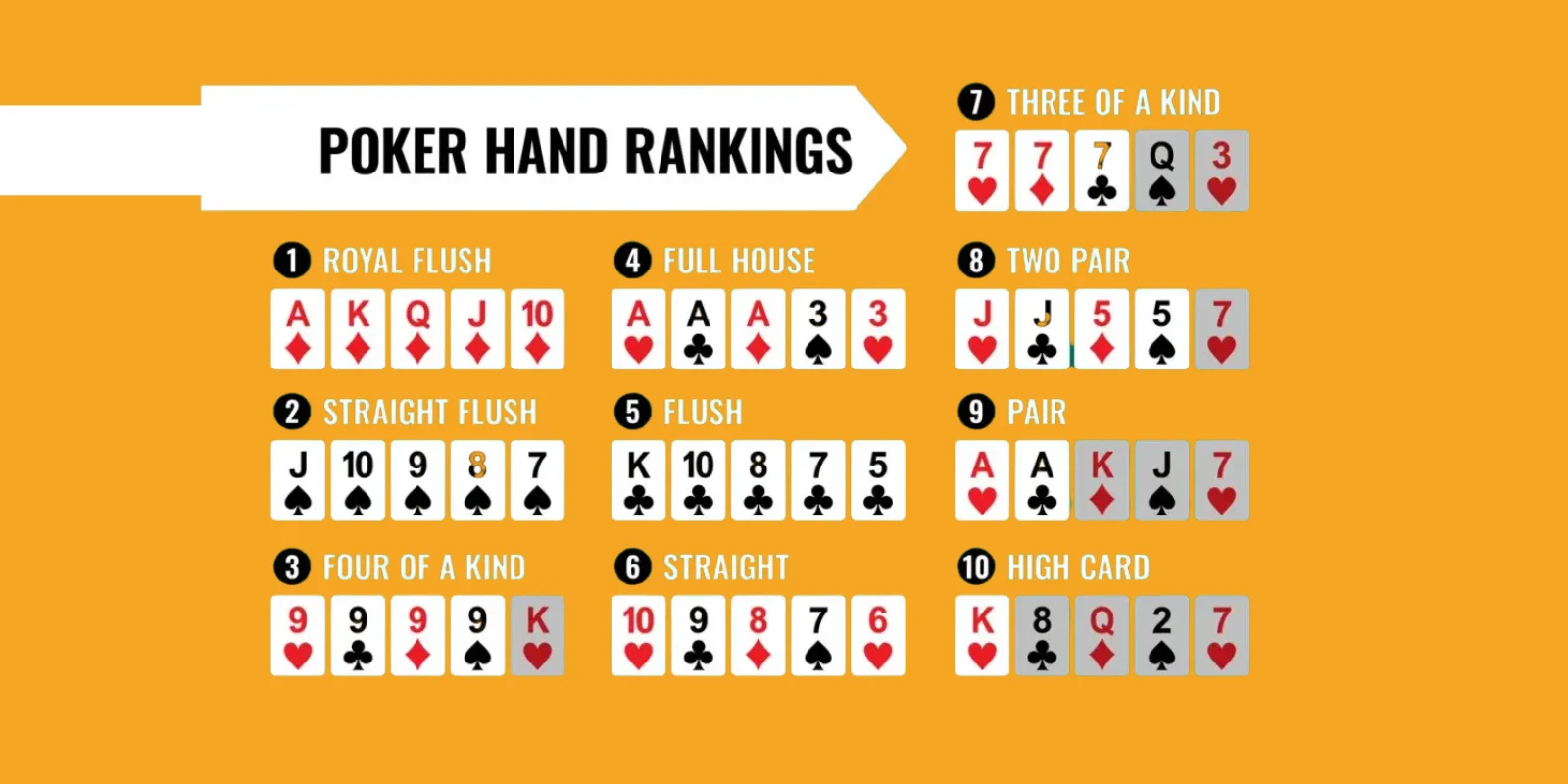
These rankings apply to all standard poker variants including Texas Holdem and Omaha. Memorize them completely before playing your first hand. In poker, you always use the best five-card combination available to you.
| Rank | Hand | Description | Example | Probability (5-card) |
|---|---|---|---|---|
| 1 | Royal Flush | A-K-Q-J-10 all same suit | A-K-Q-J-10 of spades | 0.000154% |
| 2 | Straight Flush | Five consecutive, same suit | 5-6-7-8-9 of hearts | 0.00139% |
| 3 | Four of a Kind | Four cards same rank | K-K-K-K-3 | 0.0240% |
| 4 | Full House | Three of a kind + pair | Q-Q-Q-7-7 | 0.1441% |
| 5 | Flush | Five cards, same suit | 2-5-8-J-A all clubs | 0.197% |
| 6 | Straight | Five consecutive cards | 4-5-6-7-8 mixed suits | 0.392% |
| 7 | Three of a Kind | Three cards same rank | 9-9-9-4-2 | 2.11% |
| 8 | Two Pair | Two different pairs | J-J-5-5-K | 4.75% |
| 9 | One Pair | Two cards same rank | A-A-7-4-2 | 42.3% |
| 10 | High Card | No matching cards | A-K-8-5-3 | 50.1% |
In Teen Patti, A-2-3 is the highest sequence. In poker, A-K-Q-J-10 is the highest straight. In Teen Patti, "Color" (flush) ranks below sequence. In poker, flush ranks above straight. These differences are critical if you play both games. Also, poker uses five-card hands while Teen Patti uses three-card hands, fundamentally changing the probabilities.
Texas Holdem Rules - Complete Walkthrough
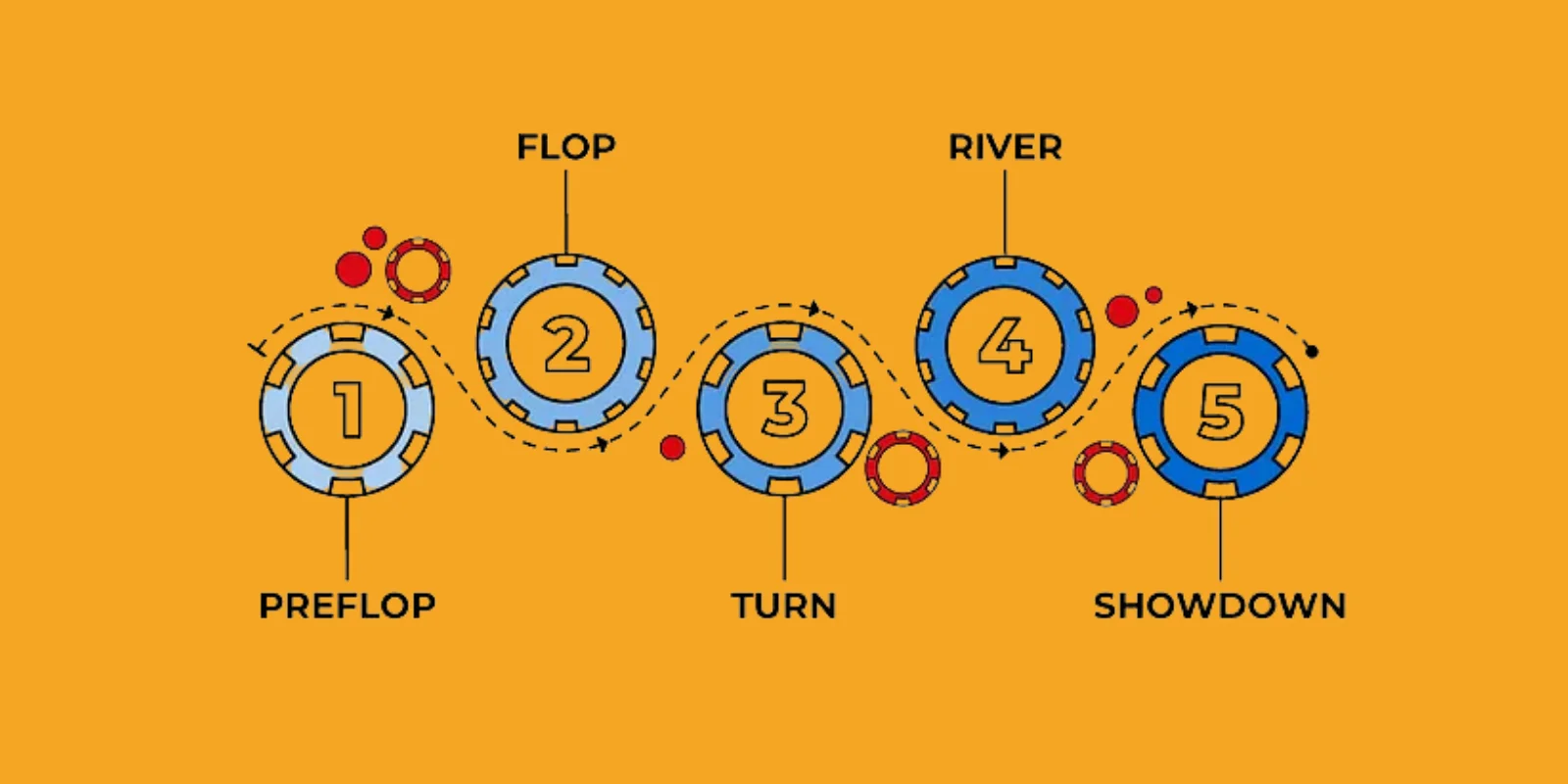
Texas Holdem is the most popular poker variant and the format used in virtually all major poker tournaments including the World Series of Poker. Each player receives two private cards (hole cards). Five community cards are dealt face-up on the table in three stages. Players make the best five-card hand using any combination of their two hole cards and the five community cards.
Blinds, Button, and Dealing
Before cards are dealt, two forced bets are placed: the small blind (posted by the player to the left of the dealer button) and the big blind (posted by the next player, typically double the small blind). These forced bets create a pot to compete for and ensure action in every hand. The dealer button rotates clockwise after each hand, so everyone takes turns posting blinds.
Each player then receives two face-down cards (hole cards) that only they can see. These two cards, combined with the five community cards, will form your final hand.
Pre-Flop (First Betting Round)
Starting with the player to the left of the big blind, each player can: Fold (discard cards, leave the hand), Call (match the big blind amount), or Raise (increase the bet). Action continues clockwise. The big blind acts last and can check (stay without betting more) if no one has raised, call a raise, or re-raise.
This is where starting hand selection is critical. Most hands dealt in poker should be folded pre-flop. Professional players typically play only 15 to 25 percent of their starting hands, folding the rest before seeing the flop.
The Flop (Second Betting Round)
The dealer places three face-up community cards on the table. This is the flop. A new betting round begins, starting with the first remaining player to the left of the dealer. Players can now: Check (pass action without betting, only if no one has bet), Bet (place a wager), Call (match a bet), Raise (increase a bet), or Fold. The flop reveals 71% of the community cards, making it the most important moment for hand evaluation.
The Turn (Third Betting Round)
A fourth community card is placed face-up (the turn card). Another betting round follows with the same options. The turn card can dramatically change hand strengths. A player who was behind after the flop might complete a flush or straight with the turn card.
The River (Final Betting Round)
The fifth and final community card is placed face-up (the river). The last betting round follows. After this round, if two or more players remain, a showdown occurs. The river is where the biggest bluffs happen, as it is the last chance to bet before cards are revealed.
Showdown
Remaining players reveal their hands. The player with the best five-card combination (using any combination of their two hole cards and the five community cards) wins the pot. If two players have identical hands, the pot is split equally.
Omaha Poker
Omaha is the second most popular poker variant globally and has a rapidly growing player base in India. The rules are similar to Texas Holdem with two crucial differences that fundamentally change the strategy:
Difference 1: Four hole cards. Each player receives four private cards instead of two. This creates significantly more possible hand combinations, which means hands at showdown are typically much stronger than in Holdem. In Holdem, top pair is often a winning hand. In Omaha, top pair is almost never good enough because at least one opponent is likely to have two pair, a straight, or a flush.
Difference 2: Must use exactly two. At showdown, you must use exactly two of your four hole cards combined with exactly three of the five community cards. This "must use two" rule is the single most common source of confusion and mistakes for players transitioning from Holdem to Omaha.
Example of the "must use two" trap: The community board shows A-K-Q-J-10 (a straight on the board). In Holdem, every remaining player would share this straight. In Omaha, you must contribute exactly two cards from your hand. If your four hole cards are 2-3-5-7, you cannot make a straight at all despite the board having one, because no combination of two cards from your hand plus three from the board creates a five-card straight.
Another example: You hold Ah-3h-8d-9d. The board is Kh-7h-2h-Qs-Jd. You might think you have a flush (three hearts on the board plus the Ah in your hand). But you need TWO cards from your hand, so your flush would be Ah-3h from your hand plus Kh-7h-2h from the board, minus one board card (since you can only use three). Wait: Ah-3h plus Kh-7h-2h = five cards, using two from hand and three from board. This IS a flush. But if you only had one heart in your hand (say Ah-8d-9d-Qs), you would NOT have a flush because you need two hole cards and can only supply one heart.
Omaha strategy adjustments:
- Play starting hands with coordinated cards (cards that work together: suited, connected, paired). Hands like Ah-Kh-Qd-Jd are premium because all four cards can contribute to strong combinations.
- Do not overvalue small flushes. In Holdem, any flush is usually a winning hand. In Omaha, with four hole cards per player, there are many more flush possibilities. A small flush (like 5-high flush) is often beaten by a higher flush.
- The nuts (the best possible hand given the board) changes more frequently in Omaha than Holdem. Always evaluate whether your strong hand could be beaten by a stronger combination that someone else could hold.
- Pot Limit Omaha (PLO) is the standard format, meaning you can bet up to the current pot size but not more. This creates different dynamics than No Limit Holdem.
Position Strategy
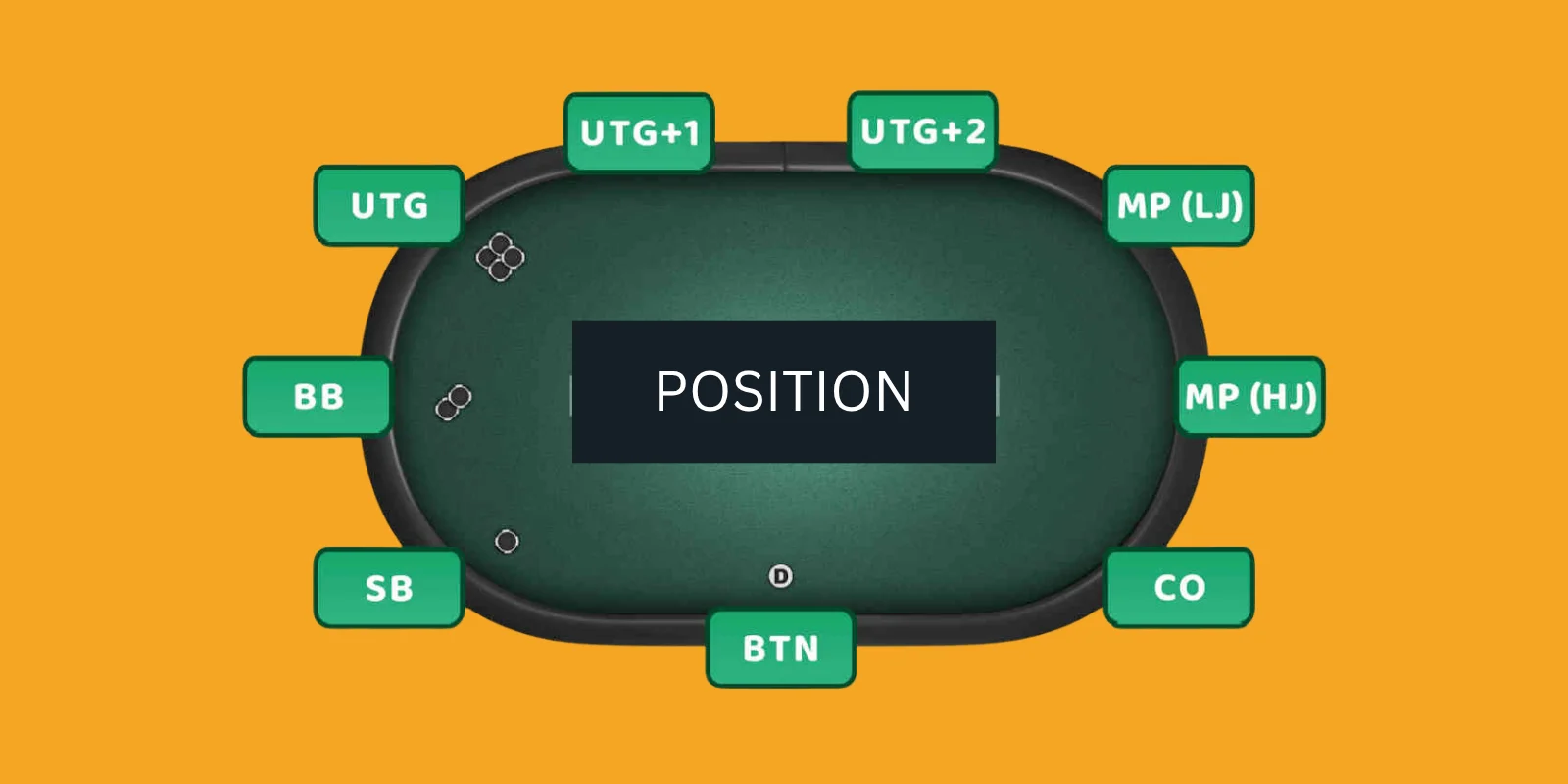
Position is one of the most important concepts in poker. The player who acts later in the betting round has a massive advantage because they see what everyone else does before making their decision. The "button" (dealer position) is the most advantageous because you act last in every post-flop betting round.
| Position | Also Called | Advantage | Recommended Play |
|---|---|---|---|
| UTG (Under the Gun) | Early position | Worst (acts first post-flop) | Play very tight: premium pairs, A-K, A-Q only |
| Middle Position | MP1, MP2 | Moderate | Slightly wider: add medium pairs, suited connectors |
| Cutoff | CO (one before button) | Good | Wide range: most pairs, suited cards, connectors |
| Button | BTN (dealer) | Best (acts last) | Widest range: play most playable hands |
| Small Blind | SB | Bad (acts second-to-last pre, first post) | Defend with decent hands, fold trash |
| Big Blind | BB | Poor (forced investment, bad position) | Defend wider since you have money in already |
Why position matters in practice: Imagine you hold J-10 suited. From early position, this is a marginal hand because 6 or more players will act after you, and any of them could have a premium hand. From the button, the same J-10 suited is a strong hand because only the blinds remain, you have position for the entire hand, and you can read their actions before deciding.
A simple rule: the later you act, the more hands you can profitably play. Many professional players play 10% of hands from early position but 35% or more from the button.
Starting Hand Selection
Choosing which hands to play pre-flop is the most fundamental poker skill. Playing too many weak hands is the single biggest mistake beginners make and the primary reason they lose money.
| Tier | Hands | When to Play |
|---|---|---|
| Premium (always play) | A-A, K-K, Q-Q, A-Ks, A-Ko | Any position. Raise or re-raise. |
| Strong | J-J, 10-10, A-Qs, K-Qs, A-Jo | Any position. Raise or call a raise. |
| Playable | 9-9, 8-8, A-Js, K-Jo, Q-Js, J-10s | Middle to late position. Raise or call. |
| Speculative | Small pairs (2-7), suited connectors (5-6s, 7-8s), suited aces (A-2s to A-9s) | Late position only. Call cheaply, fold to raises. |
| Fold | Everything else | Fold pre-flop. Do not play these hands. |
The "s" means suited (same suit), "o" means offsuit (different suits). Suited hands are about 3 to 4 percent more profitable than their offsuit equivalents because of flush potential.
Roughly 80% of your poker profits will come from about 20% of the hands you play. Premium and strong hands generate the vast majority of your winnings. Speculative hands occasionally hit big (flopping a set with a small pair, making a flush with suited connectors) but most of the time they contribute small losses. The discipline to fold marginal hands pre-flop is what separates winning players from losing ones.
Pot Odds, Implied Odds, and Poker Math
Understanding poker math is the foundation of profitable decision-making. You do not need to be a mathematician, but you must understand pot odds and how to apply them in real-time.
Pot odds compare the cost of calling a bet to the size of the pot. If the pot contains 1,000 rupees and your opponent bets 200 rupees, the pot is now 1,200 rupees and you must pay 200 to call. Your pot odds are 1,200 to 200, or 6 to 1. This means you need to win at least 1 out of 7 times (14.3%) to break even on the call.
Outs are the cards remaining in the deck that will improve your hand. If you have four cards to a flush after the flop (four hearts), there are 9 remaining hearts in the deck (13 total minus your 4). These 9 cards are your "outs."
The Rule of 2 and 4: A quick method to estimate your chance of hitting an out. After the flop (two cards to come), multiply your outs by 4 for the approximate percentage. After the turn (one card to come), multiply by 2. With 9 flush outs on the flop: 9 x 4 = 36% chance of completing the flush by the river. With 9 outs on the turn: 9 x 2 = 18% on the river card alone.
| Outs | Example Draw | Flop to River | Turn to River |
|---|---|---|---|
| 2 outs | Pocket pair to set (one overcard on board) | 8.4% | 4.3% |
| 4 outs | Gutshot straight draw | 16.5% | 8.7% |
| 8 outs | Open-ended straight draw | 31.5% | 17.4% |
| 9 outs | Flush draw | 35.0% | 19.6% |
| 12 outs | Flush draw + gutshot | 45.0% | 26.1% |
| 15 outs | Flush draw + open-ended straight | 54.1% | 32.6% |
Applying pot odds: If you have a flush draw (9 outs, ~35% chance by river) and the pot offers better than 2 to 1 odds, calling is mathematically correct. If the pot offers only 1 to 1, folding is correct because you will miss the flush about 65% of the time. This objective framework removes emotion from decision-making.
Implied odds go beyond pot odds by estimating how much more money you will win on future betting rounds if you hit your draw. If the pot currently offers poor odds for your flush draw but you expect your opponent to call a large bet on the river if you hit, the implied odds may justify calling. Implied odds are especially important with drawing hands against opponents who have difficulty folding strong made hands.
Bluffing Strategy
Bluffing is betting or raising with a hand you believe is weaker than your opponent's, with the goal of making them fold a better hand. Successful bluffing is one of poker's most celebrated skills, but it is also one of the most misunderstood.
Semi-bluff: The most profitable type of bluff. You bet with a hand that is currently behind but has the potential to improve (a draw). If your opponent folds, you win immediately. If they call, you still have outs to win. Example: betting with a flush draw on the flop. You have about 35% equity, and if your opponent folds even 30% of the time, the semi-bluff is profitable.
Pure bluff: Betting with a hand that has virtually no chance of improving. Pure bluffs should be used sparingly and in specific situations: on the river when no more cards are coming, against opponents who have shown weakness, and when your betting pattern throughout the hand tells a believable story of strength.
Bluffing frequency: Game theory suggests that in optimal play, you should bluff roughly one-third as often as you value bet. If you bet three times with strong hands, bet once with a bluff. This ratio makes you unpredictable and prevents opponents from always calling (or always folding) against your bets.
Bluff sizing: Your bluff bet should be the same size as your value bet in the same situation. If you typically bet 60% of the pot with strong hands, bluff at 60% too. Varying your bet size based on hand strength is a common tell that observant opponents will exploit.
Never bluff against calling stations (players who call everything). Never bluff multiple opponents simultaneously (too many players to fold). Never bluff when you are on tilt (emotional decisions are almost always wrong). Never bluff the river when the pot is very large relative to remaining stacks (opponents are pot-committed and will call with anything).
Bet Sizing Strategy
How much you bet is almost as important as whether you bet. Correct bet sizing maximizes your profit with strong hands and minimizes your cost with bluffs. The three most common bet sizing philosophies are:
Small ball (25 to 40% pot): Betting a small fraction of the pot reduces your risk when bluffing and still charges opponents with draws. This style works well against opponents who fold frequently because you risk less when your bluff is called. The downside is that opponents get cheap looks at additional cards.
Standard sizing (50 to 75% pot): The most common sizing used by intermediate and professional players. It balances risk and reward. A 60% pot bet is large enough to deny draws correct odds in most situations while keeping the pot manageable. This is the default sizing you should start with.
Overbet (100%+ pot): Betting more than the pot is an advanced technique used in specific situations. Overbets work best when you have a polarized range (either a very strong hand or a bluff, never something in between) and your opponent has a capped range (they cannot have the strongest possible hands because their previous actions rule them out). For example, overbetting the river on a board with four to a flush when you know your opponent does not have a flush.
Sizing by street: As a general framework, bet sizes should often increase as the hand progresses. A common pattern is 33% pot on the flop, 66% on the turn, and 75 to 100% on the river. This "geometric" sizing pattern builds the pot efficiently for value hands while keeping fold equity available for bluffs on later streets.
Post-Flop Play Framework
Post-flop play (after the first three community cards are dealt) is where most poker profit and loss occurs. A structured approach to post-flop decisions dramatically improves your results.
Step 1: Evaluate your hand category
After seeing the flop, categorize your hand into one of these groups:
| Category | Example | Action |
|---|---|---|
| Monster (top 3% of hands) | Set (three of a kind), two pair, straight, flush, full house | Bet for value. Build the pot. Do not slow-play unless the board is very dry. |
| Strong made hand | Top pair with good kicker, overpair | Bet for value and protection. Be cautious on scary turn and river cards. |
| Medium made hand | Middle pair, top pair with weak kicker | Check or small bet. Keep the pot controlled. Fold to heavy aggression. |
| Drawing hand | Flush draw, straight draw, open-ender + pair | Semi-bluff or call based on pot odds. Hit or fold by the river. |
| Weak/nothing | Missed flop entirely, bottom pair, no draw | Check-fold unless bluffing. Do not put more money in with nothing. |
Step 2: Consider board texture
Dry boards (like K-7-2 with three different suits) are unlikely to have helped anyone with a flush draw or straight draw. On dry boards, you can bet smaller for value and bluff more frequently because opponents will fold most missed hands.
Wet boards (like J-10-9 with two hearts) are dangerous because many possible draws exist. On wet boards, bet larger to charge draws and bluff less because opponents have more reasons to call.
Step 3: Assess your opponent's likely range
Based on their pre-flop actions and position, estimate what hands they might hold. Did they raise from early position (likely strong hands only)? Did they call from the big blind (could be a wide range)? Did they three-bet pre-flop (likely premium hands)? Their range narrows as the hand progresses and they take actions that eliminate possibilities.
Step 4: Plan your action for all streets
Before betting the flop, think about what you will do on the turn and river. If you continuation bet the flop, will you bet again on the turn? On what cards? If you check the flop, will you check-raise or check-call? Planning multiple streets ahead prevents you from making disconnected decisions that do not tell a coherent story.
{img("poker-postflop-framework.webp", "Framework diagram for post-flop poker decisions showing hand evaluation board texture opponent range assessment and multi-street planning")}Bankroll Management for Poker
Because poker has significant short-term variance (even the best players lose individual sessions regularly), proper bankroll management is essential for survival. Your poker bankroll is the total amount of money you have dedicated specifically to poker, completely separate from your living expenses, savings, and other financial obligations. Never play poker with money you cannot afford to lose.
The reason bankroll management matters is mathematical: even a player who wins 60% of sessions will occasionally experience a losing streak of 5 or more sessions in a row. Without sufficient bankroll depth, a normal losing streak can wipe out a player who would otherwise be profitable long-term. The bankroll acts as a cushion that absorbs these inevitable downswings.
| Game Type | Recommended Bankroll | Example | Reasoning |
|---|---|---|---|
| Cash games (conservative) | 30 buy-ins | 500 rupee buy-in = 15,000 bankroll | Handles extended downswings safely |
| Cash games (aggressive) | 20 buy-ins | 500 rupee buy-in = 10,000 bankroll | More risk, faster stake progression |
| Tournaments (conservative) | 100 buy-ins | 200 rupee buy-in = 20,000 bankroll | Tournaments have higher variance than cash |
| Tournaments (aggressive) | 50 buy-ins | 200 rupee buy-in = 10,000 bankroll | Acceptable if you are a strong player |
Move down before moving up: If your bankroll drops below the recommended level for your current stake, move down to a lower stake immediately. Playing above your bankroll is the fastest way to go broke in poker, regardless of skill level. Conversely, when your bankroll grows to support a higher stake comfortably (30+ buy-ins at the next level), you can consider moving up.
Separate poker money from personal money: Maintaining a dedicated poker account (online or in cash) creates a clear boundary. If you win, the bankroll grows and you can play higher stakes. If you lose, you see the damage clearly and can make rational decisions about whether to continue. Mixing poker money with personal finances makes it impossible to track your results accurately and often leads to playing stakes you cannot afford.
Session bankroll vs total bankroll: Beyond your total bankroll (the full amount dedicated to poker), set a session stop-loss. A common rule is to stop playing a session if you lose 3 buy-ins. This prevents a single bad session from doing catastrophic damage to your bankroll. If you are playing well but running badly (losing despite making correct decisions), stopping preserves capital. If you are playing badly (making emotional decisions), stopping prevents further damage.
The mental side of bankroll management: Playing at stakes that are too high for your bankroll creates "scared money" psychology. You become afraid to bet, call, and raise in situations where these actions are mathematically correct. This fear-based play is actually worse than your normal game, creating a cruel cycle: you move up to make more money, play worse because the stakes feel too high, and lose more. The antidote is always having enough bankroll that each individual hand feels routine rather than dramatic.
Common Poker Mistakes
- Playing too many hands pre-flop. The number one mistake. Most starting hands are unprofitable. Fold more, play fewer hands, play them aggressively. A simple rule: if you would not be comfortable raising with the hand, you probably should not be calling with it either.
- Ignoring position. Playing the same hands from every position is a massive leak. From UTG (early position), play only premium hands. From the button (late position), play a much wider range. Position is so important that a mediocre hand on the button is often more profitable than a strong hand from UTG.
- Calling too much, raising too little. Calling is the weakest action in poker. Raising gives you two ways to win: your opponent folds (you win the pot uncontested), or you have the best hand at showdown. Calling only wins if you have the best hand. Professional players refer to chronic calling as "calling station" play, and it is one of the biggest leaks in beginner poker.
- Not using pot odds. Making decisions based on gut feeling instead of mathematics leads to long-term losses. Learn the Rule of 2 and 4 and apply it to every drawing decision. If the math says fold, fold. If the math says call, call. Emotions are irrelevant to correct poker math.
- Showing emotions (tilt). After a bad beat (losing a hand where you were statistically favoured), the temptation to play aggressively to recover is overwhelming and destructive. Bad beats are a mathematical certainty in poker. They are not unfair, they are simply the natural variance of a probability-based game. Take a break when you feel frustrated, angry, or desperate.
- Overvaluing top pair. In Holdem, top pair with a good kicker is a decent hand, but it is far from unbeatable. Many beginners lose their entire buy-in with top pair against two pair, sets (three of a kind), straights, and flushes. When facing aggressive action (multiple raises or large bets on later streets), consider that your top pair might be behind.
- Slow-playing too often. Slow-playing (checking with a strong hand to trap opponents) is occasionally correct but is massively overused by beginners who watched too many poker movies. Most of the time, betting your strong hands is more profitable because it builds the pot, charges draws (making them pay to try to improve), and prevents opponents from seeing free cards that might beat you.
- Not adjusting to opponents. Playing the same strategy against every opponent is a losing approach. Against aggressive players: tighten your range and let them bet into your strong hands. Against passive players: bet more frequently since they will call with weak hands. Against tight players: bluff more since they fold frequently. Against loose players: bluff less and value bet more.
- Playing outside your bankroll. Sitting at a table where the buy-in represents more than 5% of your total poker bankroll is gambling, not playing poker. One bad session can eliminate you entirely. Proper bankroll management ensures you can weather the inevitable downswings that occur even for the best players.
- Neglecting study and review. Poker is a game of continuous learning. Players who study hand histories, review their decisions, and learn from mistakes improve over time. Players who simply play without reflection stagnate and eventually fall behind as the overall skill level rises.
Reading Opponents in Poker
In live poker, physical tells provide information about opponents' hands. In online poker, betting patterns and timing are the primary information sources. Both environments reward careful observation.
Live Poker Tells
Bet sizing tells: Many recreational players bet small with weak hands (hoping you will call) and large with strong hands (trying to protect). If you notice this pattern, adjust: fold to large bets and call or raise against small ones.
Timing tells: A snap-call usually means a drawing hand or a medium-strength hand (the player made an automatic decision without much thought). A long pause followed by a raise typically indicates genuine strength, as the player was considering how much to raise. A long pause followed by a call often indicates a marginal hand where the player was considering folding.
Verbal tells: Players who talk about the strength of their hand often mean the opposite of what they say. "I probably should fold" followed by a call usually means a strong hand. Silence or a sudden change in chattiness often indicates the player is concentrating because they have a decision-worthy hand.
Physical tells: Hands that tremble slightly often indicate a very strong hand (adrenaline response to a big hand, not nervousness about bluffing). Looking away from the pot nonchalantly often means the player wants you to bet (they have a strong hand). Staring at you intently after betting often means they are bluffing (trying to intimidate you into folding).
Online Poker Tells
In online poker on CricBet99, you cannot see opponents physically but can read their behaviour through:
- Bet sizing consistency: Track whether opponents use the same bet size with strong and weak hands. Many do not.
- Action timing: Instant checks usually mean weakness. Delayed bets often mean strength (the player was considering how much to bet). Pre-selected auto-actions (instant calls or raises) can indicate the player made their decision before you acted.
- Frequency patterns: How often does this player raise pre-flop? How often do they continuation bet the flop? How often do they fold to a raise? These frequencies reveal their overall strategy and allow you to exploit deviations.
- Multi-table indicators: If a player is taking the same amount of time on every decision, they may be playing multiple tables and making automatic decisions rather than thinking deeply about each situation. This can be exploited by making unusual plays that require a thoughtful response.
Advanced Poker Concepts
Expected Value (EV) and Long-Term Thinking
Every poker decision has an expected value (EV): the average amount you expect to win or lose over many repetitions of the same situation. Positive EV (+EV) decisions make money over time. Negative EV (-EV) decisions lose money. The goal of poker is to make as many +EV decisions as possible, regardless of whether individual hands win or lose.
Example: You have a flush draw on the turn (9 outs, ~19.6% chance). The pot is 2,000 rupees, and your opponent bets 300 rupees. Pot odds: 2,300 to 300 = 7.7 to 1. You need to win 11.5% of the time to break even. With 19.6% equity, calling is +EV. Over 1,000 similar situations, you will lose about 804 times (each losing 300) and win about 196 times (each winning 2,300). Net result: +196 x 2,300 - 804 x 300 = +450,800 - 241,200 = +209,600 rupees profit from 1,000 correct calls.
This long-term mathematical framework is what makes poker a skill game. Individual results are random, but the pattern over thousands of hands rewards correct decisions relentlessly.
Continuation Betting (C-Betting)
A continuation bet (c-bet) is a bet made on the flop by the pre-flop raiser, regardless of whether the flop improved their hand. The logic: if you raised pre-flop showing strength, betting the flop continues that story. Since the flop misses most hands most of the time, opponents frequently fold to c-bets.
Optimal c-bet frequency is approximately 60 to 70 percent of flops. Bet more on dry boards (no obvious draws) and less on wet boards (many possible draws). C-bet sizes should be 50 to 66 percent of the pot on dry boards and 33 to 50 percent on wet boards.
Three-Betting and Four-Betting
A three-bet is re-raising a player who has already raised pre-flop. A four-bet is re-raising a three-bet. These aggressive plays are used for value (with premium hands) and as bluffs (with suited connectors or small pairs that play well multi-way but can also benefit from fold equity).
A balanced three-betting range typically includes about 60-70% value hands (strong pairs, A-K, A-Q suited) and 30-40% bluffs (suited connectors, suited aces like A-5 suited). This balance prevents opponents from exploiting your three-bets by always folding (if you only three-bet with premiums) or always calling (if you three-bet too liberally).
Cash Games vs Tournaments
| Aspect | Cash Games | Tournaments |
|---|---|---|
| Buy-in | Any time, rebuy any time | Fixed entry, one buy-in (sometimes with rebuy period) |
| Blinds | Fixed throughout | Increase on a schedule (creates urgency) |
| Stack depth | Typically deep (100+ big blinds) | Varies from deep to shallow as blinds increase |
| Leaving | Leave any time with your chips | Must play until eliminated or win |
| Skill emphasis | Post-flop play, reading opponents | Pre-flop aggression, stack management, ICM |
| Variance | Lower (steady, session-based results) | Higher (most sessions end in elimination) |
| Best for | Consistent income, flexible schedule | Large payouts, competitive atmosphere |
In tournaments, an additional concept called ICM (Independent Chip Model) affects optimal strategy. As you approach the money (the payout threshold), each chip you have is worth less than its face value because busting out means earning nothing. This means you should avoid marginal all-in situations near the bubble, even if they are +EV in chip value, because losing would cost more real money than winning would gain.
Case Studies
Case Study 1: The Value of Position
Your hand: A-Q offsuit. Position: Button (best position).
Pre-flop: Early position player raises to 300 rupees. Two players fold. You call on the button. Blinds fold. Heads-up. Pot: 750.
Flop: A-7-2 rainbow (no flush draw). Opponent bets 400. You have top pair with a Queen kicker, which is strong on this dry board. You call. Pot: 1,550.
Turn: 5 (irrelevant). Opponent checks. This check tells you they are uncertain. You bet 800 for value. Opponent calls. Pot: 3,150.
River: 3 (irrelevant). Opponent checks again. You bet 1,500 for value. Opponent calls with A-J (top pair, weaker kicker). You win.
Lesson: Your position allowed you to control the pot size, bet when they showed weakness, and extract maximum value. From early position, you would have had to act first without knowing their intentions.
Case Study 2: Correct Use of Pot Odds
Your hand: 9-10 of hearts. Flop: 7h-8h-Kd. You have an open-ended straight draw (any 6 or Jack completes the straight = 8 outs) PLUS a flush draw (any heart = 9 additional outs, minus the 6h and Jh already counted = 7 additional unique outs). Total: 15 outs, approximately 54% chance of completing by the river.
Opponent bets 500 into a 1,000 rupee pot. Pot is now 1,500. You need to call 500. Pot odds: 1,500 to 500 = 3 to 1. You need to win 25% of the time. With 54% equity, calling is extremely profitable. You call.
Turn: 6 of clubs. You made a straight (6-7-8-9-10). You bet 1,200 into 2,000. Opponent calls with K-Q (top pair). River is irrelevant. You win a large pot.
Lesson: Mathematics justified the call on the flop. Even if the turn had not completed your hand, the river still gave another chance. Over hundreds of similar situations, calling with these odds generates significant profit.
Case Study 3: A Successful Multi-Street Bluff
Your hand: 6-7 of spades. Position: Cutoff.
Pre-flop: You raise to 250 with a speculative suited connector. Only the big blind calls. Pot: 550.
Flop: A-9-3 rainbow. You missed completely. But you raised pre-flop, so your opponent expects strong cards. You continuation bet 300 (55% pot), representing an Ace. Big blind calls. Pot: 1,150. Their call suggests a medium pair or weak Ace.
Turn: King of spades. Another overcard that helps your story. You bet 650. Big blind calls hesitantly. Pot: 2,450. Hesitation plus calling (not raising) suggests a pair of 9s or similar medium hand.
River: 2 of diamonds. Board: A-9-3-K-2, no flush possible. You have nothing (7 high). But your betting tells a consistent story of strength across three streets. You bet 1,800 (73% pot). Big blind tanks for 30 seconds and folds their pocket 9s.
Analysis: This bluff worked because: (1) your pre-flop raise was consistent with strong holdings, (2) the A and K on the board aligned with your story, and (3) the opponent had a medium hand strong enough to call individual bets but too weak to withstand sustained pressure. Successful bluffs tell a coherent story across all streets. If you had checked the turn and then bet the river, the inconsistency would have triggered a call.

Playing Poker on CricBet99
CricBet99 offers Texas Holdem and Omaha poker with real opponents. Cash games let you join and leave at any time with real money at stake on every hand. Tournaments run on regular schedules with buy-in amounts ranging from casual to competitive.
To start playing: get your CricBet99 ID on WhatsApp, deposit funds using UPI, Paytm, or bank transfer, and navigate to the poker section. Tables are available around the clock at various stake levels.
For other casino games: Teen Patti, Roulette, Blackjack, Baccarat, Slots. For sports betting: Cricket Betting, Odds Explained.
Learn more: Poker on Wikipedia, Texas Holdem on Wikipedia.
Play Poker on CricBet99
Texas Holdem and Omaha poker with real opponents and live dealers. Test your skills against players from across India.
Start Playing Poker NowIf betting is affecting your daily life, please seek help through iCall India and Vandrevala Foundation. Read our Responsible Gambling page.
Frequently Asked Questions
A Royal Flush (A-K-Q-J-10 all same suit) is the highest-ranking hand. It occurs approximately once in 650,000 five-card hands.
Start by memorizing hand rankings, learn position play (play tight early, loose late), understand pot odds (Rule of 2 and 4), and practice at low stakes. Study is essential, as poker rewards long-term learning.
Poker combines both. Short-term results are heavily influenced by luck (card distribution), but over thousands of hands, skill dominates. Professional players consistently profit over years, which would be impossible in a pure luck game.
In Holdem you get 2 hole cards and can use any combination with 5 community cards. In Omaha you get 4 hole cards but MUST use exactly 2 of them with exactly 3 community cards. Omaha produces stronger hands at showdown.
Most professionals play 15-25% of starting hands. Beginners should start even tighter at 10-15% until they understand post-flop play. Fold everything not in the premium, strong, or playable tiers.
Pot odds compare the cost of calling to the pot size. If the pot is 1,000 and you must call 200, the odds are 5:1. You need to win more than 1 in 6 times (16.7%) to profit. Compare this to your hand's equity to make correct decisions.
Yes. CricBet99 offers real-money Texas Holdem and Omaha. Get your ID on WhatsApp, deposit funds, and start playing against real opponents.
Starting hand selection and position awareness. Most losses come from playing weak hands in bad position. Mastering which hands to play from which positions will improve your results more than any other single skill.