Blackjack Guide - Rules and Basic Strategy
Blackjack (also called "21") is the most skill-based casino table game. Your decisions directly affect the outcome, making it possible to reduce the house edge to as low as 0.5% with proper play. No other casino game offers this level of player control. The objective is simple: get a hand total closer to 21 than the dealer without going over ("busting"). But the strategy behind when to hit, stand, double, split, or surrender creates a depth that rewards study and practice, making blackjack the thinking person's casino game.
Blackjack originated from the French card game "Vingt-et-Un" (twenty-one) in the 18th century and has been a casino staple for over 200 years. Today it is the most widely played casino card game in the world. The game gained mathematical rigour in the 1960s when mathematician Edward Thorp published "Beat the Dealer," proving that skillful play and card counting could give players an edge over the house. While modern casinos have adapted to counter card counting, basic strategy remains a powerful tool available to every player. Learn more about the game's history on Wikipedia's Blackjack page.
How Blackjack Works
You play against the dealer, not other players. You and the dealer each receive two cards. One of the dealer's cards is face-up (the "upcard") and one face-down (the "hole card"). Based on your two cards and the dealer's upcard, you decide how to play. After all players have acted, the dealer reveals their hole card and follows fixed rules: they must hit on 16 or less and stand on 17 or more (some variants require dealers to hit on "soft 17," which is a hand containing an Ace counted as 11).
If your hand total exceeds 21, you "bust" and lose immediately, regardless of what the dealer has. If the dealer busts, all remaining players win. If neither busts, the hand closer to 21 wins. Ties ("pushes") result in your bet being returned.
A "blackjack" or "natural 21" is an Ace plus a 10-value card (10, Jack, Queen, or King) dealt as your first two cards. Blackjack typically pays 3:2 (1.5 times your bet), though some tables pay only 6:5 (avoid these, as they significantly increase the house edge).
Card Values
| Card | Value | Notes |
|---|---|---|
| 2 through 10 | Face value | 2=2, 3=3, ..., 10=10 |
| Jack, Queen, King | 10 | All face cards = 10 |
| Ace | 1 or 11 | Counts as 11 unless that would bust, then counts as 1 |
Hard vs Soft hands: A "soft" hand contains an Ace counted as 11 (e.g., Ace-6 = soft 17). A "hard" hand does not contain an Ace, or contains an Ace that must be counted as 1 to avoid busting (e.g., Ace-6-10 = hard 17, because counting Ace as 11 would give 27). Soft hands are more flexible because you cannot bust by taking one more card (the Ace can absorb the extra value by counting as 1 instead of 11).
Complete Blackjack Rules
- Place your bet before any cards are dealt.
- Receive two cards face-up. The dealer receives one face-up and one face-down.
- Make your playing decision based on your hand and the dealer's upcard (see Player Actions below).
- Dealer reveals hole card after all players have acted.
- Dealer follows fixed rules: must hit on 16 or less, must stand on 17 or more.
- Results: Closer to 21 wins. Bust = automatic loss. Blackjack pays 3:2. Push = bet returned.
Player Actions
- Hit: Take another card. You can hit multiple times. Risk: if your total exceeds 21, you bust and lose immediately.
- Stand: Keep your current total and end your turn. Choose this when your hand is strong enough or the risk of busting is too high.
- Double Down: Double your original bet and receive exactly one more card. Used when your starting hand is strong (typically 10 or 11) and the dealer's upcard is weak. This is one of the most profitable moves in blackjack when used correctly.
- Split: If your two cards are the same rank (e.g., two 8s, two Aces), you can split them into two separate hands, each with its own bet equal to your original. You then play each hand independently.
- Surrender: Some tables allow you to forfeit half your bet and give up the hand before taking any action. Used in very unfavourable situations (e.g., hard 16 against dealer's Ace).
- Insurance: When the dealer's upcard is an Ace, you can place a side bet (up to half your original bet) that the dealer has blackjack. Insurance pays 2:1. Never take insurance. It has a house edge over 7%.
Basic Strategy
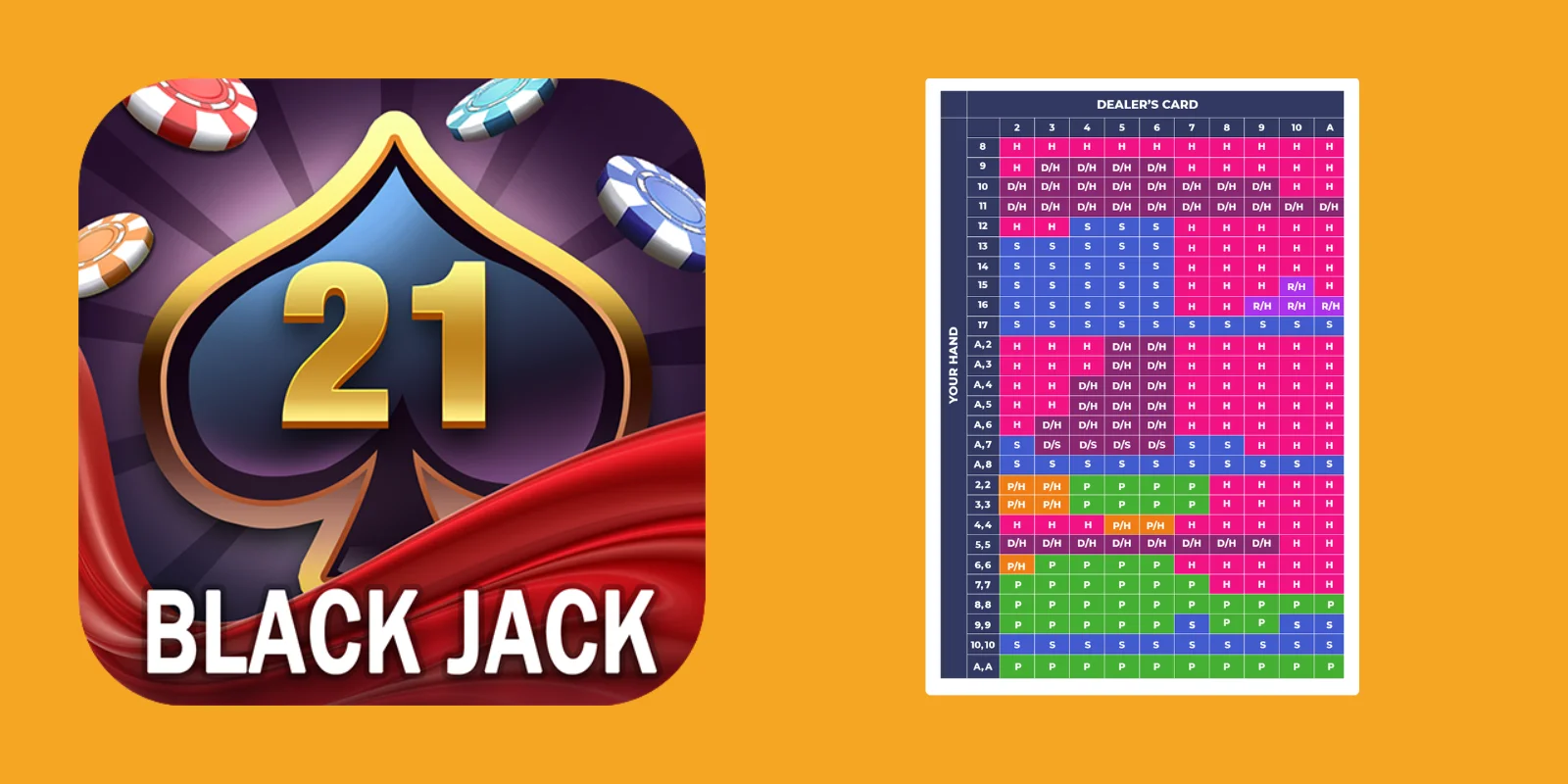
Basic strategy is a mathematically derived set of optimal decisions for every possible hand combination. It was calculated using computer simulations of millions of hands and tells you the statistically best action for every situation. Following basic strategy reduces the house edge to approximately 0.5%, making blackjack the most player-friendly table game in the casino (better than roulette at 2.70% and baccarat at 1.06%).
The key basic strategy rules to memorize:
- Always hit on hard 8 or less. You cannot bust.
- Always stand on hard 17 or more. The risk of busting is too high.
- Double down on 11 against dealer 2 through 10. This is one of the most profitable situations.
- Double down on 10 against dealer 2 through 9.
- Always split Aces. Two chances at 21 is better than one hand starting at 12.
- Always split 8s. Hard 16 is the worst hand in blackjack. Two hands starting at 8 are much better.
- Never split 10s. Hard 20 is too strong to break up.
- Never split 5s. Hard 10 is a great doubling hand. Two hands of 5 are weak.
- Stand on soft 18 (Ace-7) against dealer 2, 7, or 8.
- Hit on soft 17 (Ace-6) or less. You cannot bust and might improve.
- NEVER take insurance. The insurance bet has over 7% house edge regardless of your hand.
Basic Strategy Quick Reference Chart
This simplified chart covers the most common situations. H = Hit, S = Stand, D = Double Down, SP = Split.
| Your Hand | Dealer 2-6 | Dealer 7-A |
|---|---|---|
| Hard 8 or less | H | H |
| Hard 9 | D (vs 3-6), H (vs 2) | H |
| Hard 10 | D | D (vs 7-9), H (vs 10/A) |
| Hard 11 | D | D (vs 7-10), H (vs A) |
| Hard 12 | S (vs 4-6), H (vs 2-3) | H |
| Hard 13-16 | S | H |
| Hard 17+ | S | S |
| Soft 17 or less | H or D | H |
| Soft 18 | S (vs 2,7,8), D (vs 3-6) | H (vs 9,10,A), S (vs 7,8) |
| Soft 19+ | S | S |
| Pair of A or 8 | SP | SP |
| Pair of 10 | S | S |
| Pair of 5 | D | D (vs 7-9), H (vs 10,A) |
| Pair of 4 | H (or SP vs 5-6) | H |
| Pair of 2,3,6,7 | SP | H |
| Pair of 9 | SP (vs 2-6,8,9) | S (vs 7,10,A) |
Never take insurance. When the dealer shows an Ace, many players are tempted to "protect" their hand by taking insurance. This is a trap. Insurance is a separate side bet on whether the dealer has a 10-value card underneath. The bet pays 2:1, but the odds are roughly 2.25:1 against, giving the house a 7.7% edge on the insurance bet alone. Even when you have blackjack yourself, declining insurance and playing the hand straight is mathematically better on average.
Side Bets
Common blackjack side bets include Perfect Pairs (your first two cards are a pair), 21+3 (your two cards plus the dealer's upcard form a poker hand like flush, straight, or three of a kind), and Insurance (already discussed). Side bets carry significantly higher house edges than the main game (typically 3% to 10%+) and should be used sparingly or avoided entirely if your goal is to minimize losses.
House Edge in Blackjack
The house edge in blackjack depends on the specific rules and your play quality:
| Scenario | House Edge | Notes |
|---|---|---|
| Basic strategy, standard rules, 3:2 BJ | ~0.5% | Best case for players |
| Basic strategy, 6:5 BJ payout | ~1.4% | Avoid 6:5 tables |
| Average recreational player | ~2.0-3.0% | Errors in play increase edge |
| Poor player (no strategy) | ~5.0%+ | Random decisions are very costly |
The difference between 0.5% and 5.0% is enormous. On 100,000 rupees of total bets, a basic strategy player expects to lose 500 rupees while a random player expects to lose 5,000 rupees. Learning basic strategy is the single most valuable investment you can make as a blackjack player.
Card Counting Basics
Card counting is a technique where you track the ratio of high cards (10s, face cards, Aces) to low cards (2-6) remaining in the deck. When the remaining deck is rich in high cards, the player has an advantage because blackjacks (which pay 3:2) become more likely and the dealer is more likely to bust. When the deck is rich in low cards, the dealer has an advantage.
The Hi-Lo system (simplest counting method):
- Cards 2-6: Count +1 (low cards leaving the deck help the player)
- Cards 7-9: Count 0 (neutral)
- Cards 10-A: Count -1 (high cards leaving the deck hurt the player)
Start at 0. Add or subtract as each card is revealed. When the "running count" is highly positive (+5 or more), the deck favours the player. Increase your bets. When the count is negative, the deck favours the dealer. Bet the minimum or take a break.
Important caveats: Card counting is not illegal but casinos reserve the right to ask counting players to leave. Online blackjack with automatic shuffling after every hand (or frequent shuffling in live dealer games) makes counting ineffective because the deck composition resets. Card counting only works with physical shoes that are dealt deep before reshuffling. For online play on CricBet99, focus on perfect basic strategy rather than counting.
Blackjack Bankroll Management
A session bankroll of 20 to 40 times your average bet is recommended. If you bet 500 rupees per hand, bring 10,000 to 20,000 rupees. Set a stop-loss (leave if you lose 50% of your session bankroll) and a win target (leave if you double your session bankroll). Blackjack variance is lower than many casino games because of the ~50% win rate per hand, but losing streaks of 5 to 8 hands are common.
Common Blackjack Mistakes
- Taking insurance. The house edge on insurance is over 7%. Never take it.
- Standing on soft 17. Always hit soft 17 (Ace-6). You cannot bust and might improve significantly.
- Not doubling when you should. Failing to double on 11 against a dealer 6 is leaving money on the table.
- Splitting 10s. A hand of 20 is almost certainly a winner. Never break it up.
- Not splitting 8s. Hard 16 is the worst hand in blackjack. Two hands of 8 are far better.
- Playing at 6:5 blackjack tables. The reduced payout nearly triples the house edge compared to 3:2.
- Ignoring the dealer's upcard. Your decision should always factor in what the dealer is showing. Standing on 12 against a dealer 6 is correct. Standing on 12 against a dealer 10 is wrong.
- Chasing losses. Increasing bets after losses does not change the odds. Each hand is independent.
Case Studies
Case Study 1: The Power of Doubling Down
Your hand: 6-5 (hard 11). Dealer upcard: 6.
Correct play: Double down (double your bet, receive one card).
Why: You have an excellent starting total of 11, and the dealer has a weak upcard (6, which busts roughly 42% of the time). Any 10-value card gives you 21. Even cards like 7, 8, or 9 give you competitive totals of 18, 19, or 20. Doubling in this situation has a positive expected value of approximately +0.67 units, meaning for every 100 rupees you double, you expect to profit 67 rupees on average.
If you just hit instead: The expected value is only about +0.35 units. Doubling is nearly twice as profitable because you get more money in at a moment of maximum advantage.
Case Study 2: When to Surrender
Your hand: 10-6 (hard 16). Dealer upcard: Ace.
Correct play: Surrender (forfeit half your bet).
Why: Hard 16 against a dealer Ace is one of the worst situations in blackjack. If you hit, you bust about 62% of the time. If you stand, the dealer makes 17+ about 83% of the time. Your expected loss by playing the hand is roughly 54% of your bet. By surrendering, you lose exactly 50%. Saving 4% of your bet in the long run is significant over hundreds of these situations.
Playing Blackjack on CricBet99
CricBet99 offers live dealer and automated blackjack. Live dealer tables use real cards with professional dealers streaming in real-time. Automated tables offer faster gameplay. Both follow standard rules with 3:2 blackjack payouts. Get your CricBet99 ID on WhatsApp, deposit funds, and navigate to the casino section.
For other games: Teen Patti, Roulette, Poker, Baccarat, Slots. Learn more: Blackjack on Wikipedia.
Blackjack Variations
Several blackjack variations exist, each with slightly different rules that affect the house edge and optimal strategy:
| Variation | Key Rule Change | House Edge Impact | Strategy Change |
|---|---|---|---|
| Classic (Standard) | Dealer stands on all 17s, 3:2 BJ payout | Baseline (~0.5%) | Standard basic strategy |
| H17 (Dealer Hits Soft 17) | Dealer hits on soft 17 (Ace-6) | +0.22% worse | Double more often, surrender more |
| 6:5 Blackjack | Natural 21 pays 6:5 instead of 3:2 | +1.39% worse | Never play if 3:2 is available |
| Double Exposure | Both dealer cards face-up | +0.69% worse | Different strategy required |
| Spanish 21 | No 10-value cards in deck (face cards remain) | Varies (~0.4%) | Completely different strategy needed |
| Pontoon | British variant, "twist" and "stick" | ~0.38% | More aggressive doubling |
| Blackjack Switch | Two hands, can swap top cards | ~0.58% | Switch strategy adds complexity |
The most important takeaway: always check the blackjack payout before sitting down. A 6:5 payout instead of 3:2 increases the house edge by 1.39 percentage points, which is massive. On 100,000 rupees of total bets, the difference between 3:2 and 6:5 is approximately 1,390 rupees in extra losses. Never play at a 6:5 table when 3:2 tables are available on CricBet99.
Playing Soft Hands Correctly
Soft hands (hands containing an Ace counted as 11) are the most commonly misplayed hands in blackjack. Many players treat soft hands the same as hard hands, which is a significant mistake because soft hands have a unique property: you cannot bust by taking one more card. The Ace can absorb the additional value by converting from 11 to 1.
Soft 13 and 14 (Ace-2, Ace-3): These are weak soft hands. Always hit. Double down against dealer 5 or 6 (the weakest dealer upcards). Never stand since the totals of 13 and 14 are too low to win without improvement.
Soft 15 and 16 (Ace-4, Ace-5): Still weak. Hit against most dealer cards. Double down against dealer 4, 5, or 6. You want to improve these hands since even drawing a 10-value card only gives you hard 15 or 16, which is playable.
Soft 17 (Ace-6): This is where most beginners make a critical error. Many players stand on soft 17 because "17 sounds good." But soft 17 only beats dealer totals of 16 or less. Since the dealer must hit on 16 or less and stands on 17 or more, your soft 17 will push or lose more often than it wins. Always hit soft 17. Double down against dealer 3, 4, 5, or 6.
Soft 18 (Ace-7): The most complex soft hand. Stand against dealer 2, 7, or 8 (you have a good total and the dealer either has a weak upcard or is likely to make a hand close to yours). Double down against dealer 3, 4, 5, or 6 (exploit the dealer's weak position). Hit against dealer 9, 10, or Ace (your 18 is likely behind and you need to improve).
Soft 19 and 20 (Ace-8, Ace-9): Always stand. These are strong hands that will win most of the time. Do not get greedy trying to improve them.
Complete Splitting Guide
Splitting is one of the most profitable (and most misunderstood) plays in blackjack. When your two cards are the same rank, you can split them into two separate hands, each with its own bet. Here is the correct splitting strategy for every pair:
| Pair | Correct Play | Reasoning |
|---|---|---|
| Aces | ALWAYS split | Two chances at 21. Ace-x is the strongest starting hand. Hard 12 (A+A=12) is terrible. |
| 8s | ALWAYS split | Hard 16 is the worst hand in blackjack (busts 62% on hit). Two hands of 8 are significantly better. |
| 10s (including face cards) | NEVER split | 20 is the second-strongest hand. Never break it up. You are almost certainly winning with 20. |
| 5s | NEVER split | Hard 10 is an excellent doubling hand. Two hands of 5 are weak. Double instead of splitting. |
| 4s | Rarely split (only vs dealer 5-6) | Hard 8 is a reasonable hitting hand. Two hands of 4 are mediocre. Only split to exploit dealer weakness. |
| 9s | Split vs dealer 2-6, 8, 9. Stand vs 7, 10, A | 18 is decent but beatable. Splitting vs weak dealers and fellow 8-9 creates advantage. Stand vs 7 (your 18 wins), 10, A. |
| 7s | Split vs dealer 2-7. Hit vs 8+ | Hard 14 is weak. Two 7s have upside vs weak dealers but not worth splitting vs strong upcards. |
| 6s | Split vs dealer 2-6. Hit vs 7+ | Hard 12 is uncomfortable. Two 6s have potential vs weak dealers. |
| 3s | Split vs dealer 2-7. Hit vs 8+ | Hard 6 is too low. Two 3s give starting points with upside vs weak dealers. |
| 2s | Split vs dealer 2-7. Hit vs 8+ | Hard 4 is too low. Two 2s give starting points with upside vs weak dealers. |
The "Always Split Aces and Eights" rule is the single most important splitting rule. Memorize it first. If you remember nothing else about splitting, remember this: Aces and 8s get split regardless of what the dealer shows. The mathematics are unambiguous.
Deep Dive: Doubling Down
Doubling down is the most profitable action in blackjack when used correctly. You double your original bet and receive exactly one more card. The key is recognizing when the mathematics strongly favour your hand:
Doubling on Hard 11: This is the single most profitable situation in blackjack. Your 11 cannot bust with one card, and any 10-value card (which represents 30.8% of the deck) gives you 21. Against a dealer 2 through 10, the expected value of doubling on 11 is approximately +0.60 to +0.85 per unit bet, meaning for every 100 rupees you double, you expect to profit 60 to 85 rupees on average. Against a dealer Ace, doubling is still correct in most rule variations.
Doubling on Hard 10: Very profitable against dealer 2 through 9. Any 10-value card gives you 20, and any 9 gives you 19. The expected value is approximately +0.35 to +0.65 per unit depending on the dealer's upcard. Do NOT double against dealer 10 or Ace (the dealer is too likely to have a strong hand).
Doubling on Hard 9: Profitable only against dealer 3 through 6. Your 9 needs significant improvement, and you want the dealer to have a weak upcard. Against dealer 2, 7+, just hit.
Doubling on Soft Hands: Double soft 13-17 against dealer 5-6, soft 15-17 against dealer 4, and soft 17 against dealer 3. These soft doubles exploit the dealer's weak position while giving you a flexible hand that cannot bust.
Failing to double when correct costs you a significant amount over time. If you play 1,000 hands and have a doubling opportunity on approximately 100 of them (about 10% of hands), not doubling when you should costs you roughly 50 to 80 units of expected value. At 200 rupees per unit, that is 10,000 to 16,000 rupees of lost profit per 1,000 hands. Basic strategy is not just about knowing when to hit and stand; it is equally about doubling aggressively when the math is in your favour.
Why Insurance is Always Wrong
Insurance is offered when the dealer's upcard is an Ace. It is a separate side bet (up to half your original bet) on whether the dealer's hole card is a 10-value card (giving the dealer blackjack). Insurance pays 2:1.
The mathematics: In a standard deck, there are 16 cards worth 10 (four each of 10, J, Q, K) out of 52 total cards. After dealing, you can see two of your cards and the dealer's Ace. If your cards are not 10-value, the remaining deck has 16 tens out of 49 unseen cards. The probability of the dealer having a ten underneath is 16/49 = 32.65%. For a 2:1 insurance bet to break even, the probability needs to be 33.33% (1 in 3). Since 32.65% is less than 33.33%, insurance has a negative expected value. The house edge on insurance is 16/49 x 2 minus 33/49 x 1 = 32/49 minus 33/49 = negative. More precisely, the house edge is approximately 7.69%.
"But I have blackjack!": Many players think insurance is smart when they have blackjack ("protecting" a 3:2 payout). The mathematics say otherwise. If you have blackjack and take insurance: you win 1 unit from insurance and push on your blackjack (net +1 unit) when the dealer has blackjack, or you lose 0.5 units from insurance and win 1.5 from your blackjack (net +1 unit) when the dealer does not have blackjack. Wait, this seems like +1 unit either way, so it is always 1 unit? No, because the insurance costs 0.5 units. Without insurance: you push for 0 units (33% of the time) or win 1.5 units (67% of the time). Expected value without insurance: 0 x 0.33 + 1.5 x 0.67 = 1.005 units. Expected value with insurance: 1.0 units. Taking insurance costs you 0.005 units on average even when you have blackjack.
The bottom line: Insurance is a sucker bet designed to appeal to risk-averse players. It has a house edge over 7%, which is higher than almost any other casino bet. Never take insurance, regardless of your hand.
Card Counting: A Deeper Look
While card counting is not effective in online blackjack (due to frequent shuffling), understanding the concept deepens your appreciation of the mathematics behind the game and can be useful if you ever play physical blackjack with deep deck penetration.
Why Card Counting Works
Blackjack is unique among casino games because previous results affect future probabilities. When a deck is rich in 10-value cards and Aces, the player has advantages: blackjacks (which pay 3:2) become more likely, the dealer is more likely to bust (they must hit stiff hands while players can choose to stand), and doubling down becomes more profitable (more 10-value cards to add to your 10 or 11). When the deck is rich in low cards (2-6), the dealer has advantages: less likely to bust, blackjacks become rarer, and hitting stiff hands is safer.
The Hi-Lo System in Detail
Assign values to each card as it is revealed: 2-6 = +1 (low cards leaving the deck help the player), 7-9 = 0 (neutral), 10-A = -1 (high cards leaving the deck hurt the player). Keep a running count from zero. Convert to a "true count" by dividing by the number of remaining decks. A true count of +2 or higher indicates the deck favours the player. At true count +5 or higher, the player has a genuine mathematical edge over the house (approximately 1 to 2%).
Bet sizing with the count: The key to profitable counting is varying your bets based on the count. Bet minimum when the count is negative or low (the house has the edge). Increase to 2x to 8x your minimum when the count is high (you have the edge). This bet variation is what generates profit over time. Playing perfect basic strategy with a flat bet breaks roughly even. Adding count-based bet variation creates a positive expected value.
Why it does not work online: Online blackjack on CricBet99 uses either automatic shuffling after every hand (RNG games) or frequent shuffling in live dealer games (typically after 50% of the shoe is dealt). Card counting requires deep penetration (dealing 75%+ of the shoe before shuffling) to be effective. With shallow penetration, the count rarely becomes high enough to provide a meaningful edge.
Online Blackjack Etiquette and Tips
- Play at a pace you are comfortable with. In live dealer blackjack, there is a timer for each decision. Do not rush. Take the time you need to apply basic strategy correctly, especially for complex decisions like soft hands and splits.
- Start at low-stakes tables. Learn the interface, get comfortable with the decision flow, and verify that you can apply basic strategy consistently before moving to higher stakes.
- Use the strategy chart. Unlike physical casinos where bringing a strategy card to the table might draw attention, online you can have a basic strategy chart open on another tab or printed out. There is no disadvantage to referencing it for every decision until you have memorized the strategy completely.
- Do not play while distracted. Blackjack requires attention to every hand. Each decision matters. Playing while watching TV, cooking, or multitasking leads to errors that cost money.
- Track your results. Keep a record of your sessions (buy-in, cash-out, time played) to understand your actual win rate and identify any patterns in your play that might indicate strategy errors.
Advanced Blackjack Concepts
True Count and Deck Penetration
While card counting is ineffective online, understanding the mathematics deepens your appreciation of why blackjack is unique. The "true count" is the running count divided by the number of decks remaining. A running count of +6 with 2 decks remaining gives a true count of +3 (moderately favourable). The same +6 with 6 decks remaining gives a true count of +1 (barely favourable). True count normalises the running count across different shoe sizes.
"Deck penetration" is how deep into the shoe the dealer goes before shuffling. If 6 decks are used and the dealer cuts off 2 decks (shuffling after dealing 4 decks), the penetration is 67%. Higher penetration gives counters more opportunities to exploit high true counts. Casinos combat counting by limiting penetration to 50-60% and using automatic shufflers. Online blackjack on CricBet99 uses frequent shuffling or per-hand RNG, making counting moot.
Composition-Dependent Strategy
Basic strategy makes decisions based on hand totals (e.g., "hit on 16 against dealer 10"). However, the specific cards that make up your total can affect the optimal play in rare cases. For example, hard 16 can be 10-6, 9-7, or 8-4-4. A 10-6 (where a 10 is already used) has slightly different drawing probabilities than an 8-4-4 (where no 10s are used). These composition-dependent adjustments change the optimal play in approximately 5% of hands and improve your expected return by about 0.01%. For most players, memorising standard basic strategy is sufficient.
Risk of Ruin
Risk of ruin is the probability of losing your entire bankroll before achieving a target profit. In blackjack, even with basic strategy, losing streaks of 10+ hands occur regularly. With a 20 buy-in bankroll, the risk of ruin before doubling your money is approximately 40%. With a 100 buy-in bankroll, it drops to about 10%. This calculation demonstrates why bankroll management is critical: playing with insufficient funds dramatically increases the chance of going broke before the mathematics can work in your favour.
| Bankroll (in buy-ins) | Risk of Ruin (basic strategy) | Expected Sessions to Double |
|---|---|---|
| 10 buy-ins | ~65% | Very few succeed |
| 20 buy-ins | ~40% | Possible but risky |
| 50 buy-ins | ~15% | Achievable with discipline |
| 100 buy-ins | ~5% | Conservative, sustainable |
| 200 buy-ins | ~1% | Professional level |
Expected Value of Each Decision
Every blackjack decision has a precise expected value (EV). Understanding EV helps you make correct plays even when they feel uncomfortable:
- Doubling on 11 vs dealer 6: EV = +0.85 per unit. This is the most profitable situation. If you bet 500 rupees and double, you expect to profit 425 rupees on average.
- Splitting 8s vs dealer 10: EV = -0.48 per unit (splitting) vs -0.54 (hitting) vs -0.54 (standing). All options are negative because you are in a bad spot, but splitting loses the least. This is why you split 8s even against a 10, because "least bad" is the goal when you have a weak hand.
- Standing on 16 vs dealer 7: EV = -0.48 (standing) vs -0.41 (hitting). Hitting is better despite the bust risk because standing on 16 against a dealer 7 is almost certain to lose (dealer makes 17+ with 74% probability).
- Taking insurance with blackjack: EV = +1.00 per unit (guaranteed) vs +1.04 per unit (declining insurance, playing the hand). Declining insurance is better by 0.04 units. Small difference, but it compounds over thousands of hands.
Extended Case Studies
Case Study 3: The Split Decision
Your hand: 8-8 (hard 16). Dealer upcard: 10. Bet: 1,000 rupees.
Your instinct: "The dealer has a 10, I am going to lose either way. Why split and risk double?" This is the most common mistake recreational players make with this hand.
The mathematics: If you hit 16, you bust 62% of the time. If you stand, the dealer makes 17+ about 77% of the time (they only bust with a 6 underneath, which is 7.7% of the remaining cards). Your expected loss standing is 540 rupees. Your expected loss hitting is 539 rupees. Both are terrible.
If you split: You now have two hands of 8. Each hand draws cards independently. On average, each hand will reach a total of 17 to 18. Against the dealer's probable 20 (10+face), you still lose most of the time. But occasionally your 8 draws a 10 (getting 18), an Ace (getting 19), a 2 (getting 10, with a chance to draw again), or a 3 (getting 11, with a strong draw). Your expected loss per hand when splitting is about 480 rupees per hand, totalling 960 rupees across two hands. Wait, that seems worse (960 vs 539).
The critical insight: The EV comparison is per original bet unit. Splitting 8s vs 10 has an EV of -0.48 per original unit (lose 480 per 1000 original bet). Hitting has -0.54 per original unit (lose 540 per 1000). Splitting saves 60 rupees per original bet on average. Over 100 such situations, that is 6,000 rupees saved.
Lesson: Sometimes the correct play feels wrong because you are increasing your investment in a bad situation. But blackjack strategy is about minimising losses in bad spots, not avoiding them entirely. The 8-8 vs 10 split is the perfect example of "least bad" being the right choice.
Case Study 4: The Discipline of Standing on 12 vs Dealer 6
Your hand: 7-5 (hard 12). Dealer upcard: 6.
Your instinct: "12 is so low, I should hit." But basic strategy says stand.
Why stand: The dealer has a 6, which is the single weakest upcard. They must hit and will bust approximately 42% of the time. When they bust, you win regardless of your total (even with 12). If you hit, you risk busting (31% chance with a 10-value card). If you bust, the dealer's high bust probability is wasted because you are already out. Standing on 12 preserves your chance of winning when the dealer self-destructs.
The numbers: Standing on 12 vs 6 has an EV of -0.15 (lose 150 rupees per 1,000 bet on average). Hitting has an EV of -0.21 (lose 210 per 1,000). Standing saves 60 rupees per occurrence. Not glamorous, but these small edges compound across thousands of hands.
Blackjack Terminology
| Term | Meaning |
|---|---|
| Blackjack / Natural | Ace + 10-value card as first two cards (pays 3:2) |
| Bust | Hand total exceeding 21 (automatic loss) |
| Push | Tie between player and dealer (bet returned) |
| Hard Hand | Hand without an Ace counted as 11, or no Ace at all |
| Soft Hand | Hand containing an Ace counted as 11 |
| Upcard | Dealer's face-up card visible to all players |
| Hole Card | Dealer's face-down card |
| Hit | Take another card |
| Stand | Keep current total, end turn |
| Double Down | Double bet, receive exactly one more card |
| Split | Divide a pair into two separate hands |
| Surrender | Forfeit half bet and abandon hand |
| Insurance | Side bet on dealer having blackjack (never take it) |
| Shoe | Device holding multiple decks for dealing |
| Penetration | Percentage of shoe dealt before reshuffling |
Blackjack Myths Debunked
Several persistent myths about blackjack lead players to make costly errors:
- "The goal is to get as close to 21 as possible." Partially false. The actual goal is to beat the dealer. Sometimes the best strategy is to stand on a low total (like 12 against a dealer 6) and let the dealer bust. Getting close to 21 is a means to an end, not the goal itself.
- "Bad players at your table hurt your results." False. In the long run, other players' decisions do not affect your expected return. Sometimes a bad player's mistake will cost you a hand, but equally often their mistake will benefit you. Over thousands of hands, these effects cancel out.
- "You should always take even money with blackjack." Taking "even money" (accepting 1:1 instead of 3:2 when the dealer shows an Ace) is mathematically identical to taking insurance. It costs you approximately 0.04 units per occurrence. Always decline.
- "Always assume the dealer's hole card is a 10." This is a crude simplification. While 10-value cards are the most common (30.8% of the deck), they are NOT the majority. 69.2% of the time, the hole card is NOT a 10. Basic strategy already accounts for all possible hole cards using precise probabilities.
- "Winning and losing comes in streaks." While streaks do occur (they are a natural result of random outcomes), each hand is independent. A winning streak does not predict continued winning, and a losing streak does not predict continued losing. Adjusting your bet based on streaks is superstition, not strategy.
Blackjack vs Other Casino Card Games
| Feature | Blackjack | Baccarat | Teen Patti | Poker |
|---|---|---|---|---|
| Play against | Dealer (house) | Dealer (house) | Other players | Other players |
| Player decisions | Many (hit, stand, double, split) | One (which bet) | Several (blind, seen, bet, fold) | Many (bet, raise, fold, bluff) |
| Skill impact | High (reduces edge by ~4.5%) | None | High | Very High |
| Best house edge | 0.5% (basic strategy) | 1.06% (Banker) | N/A (player vs player) | N/A (rake only) |
| Best for | Strategic thinkers | Simplicity seekers | Social/psychology lovers | Competitive players |
Blackjack offers the lowest house edge of any casino game when played with basic strategy. The trade-off is that you must learn and consistently apply the strategy to achieve this edge. If you prefer simplicity without memorisation, baccarat offers the next best edge at 1.06% with zero strategy required (just bet Banker every hand).
Quick Start Guide for Blackjack Beginners
New to blackjack? Follow this progression to learn the game efficiently and minimise your early losses:
Week 1: Learn the three most important rules. (1) Always stand on hard 17+. (2) Always hit on hard 11 or less. (3) Never take insurance. These three rules alone eliminate the biggest mistakes beginners make and bring the house edge down significantly from the 5%+ that random play produces.
Week 2: Learn doubling and splitting basics. Always double on 11 against dealer 2-10. Always split Aces and 8s. Never split 10s or 5s. These four additional rules capture most of the remaining value from basic strategy.
Week 3: Study the full basic strategy chart. Print it out or keep it open on your phone while playing online. Refer to it for every hand until the decisions become automatic. There is no disadvantage to using a strategy reference in online blackjack.
Week 4+: Play at low stakes and track your results. After 500+ hands following basic strategy, compare your actual results to the expected house edge of 0.5%. If you are losing significantly more than 0.5%, review which situations you find most challenging and practise those specifically. Common trouble spots include soft hands (Ace-6 through Ace-8) and pairs (especially 9s).
Always play at 3:2 blackjack tables. Avoid 6:5 payout tables. This single choice reduces the house edge by 1.39 percentage points, which is the biggest impact any single decision has on your expected return.
Play Blackjack on CricBet99
Live dealer blackjack with 3:2 payouts. Master basic strategy and reduce the house edge to just 0.5%.
Start Playing BlackjackIf betting is affecting your daily life, please seek help through iCall India and Vandrevala Foundation. Read our Responsible Gambling page.
Frequently Asked Questions
Basic strategy is mathematically proven to minimize the house edge to about 0.5%. Always hit on 8 or less, stand on 17+, double on 11 vs dealer 2-10, split Aces and 8s, never split 10s or 5s, and never take insurance.
With basic strategy: approximately 0.5%. Without strategy: 2-5%. The 6:5 payout variant increases the edge to about 1.4%. Always play at 3:2 tables.
No. Insurance has a house edge over 7% and is a bad bet regardless of your hand. Always decline insurance, even when you have blackjack.
Always double on hard 11 against dealer 2-10. Double on hard 10 against dealer 2-9. These are the most profitable situations in blackjack.
Yes. Hard 16 is statistically the worst hand in blackjack. While splitting 8s against a 10 is still a losing situation on average, you lose less than you would by hitting or standing on 16.
Card counting is ineffective in online blackjack because decks are shuffled frequently (automatic shuffling) or after every hand (RNG games). Focus on perfect basic strategy for online play.
Hard 16 (particularly 10-6) is the worst hand because hitting has a high bust probability (62%) and standing almost always loses to the dealer's made hand.
Yes. CricBet99 offers live dealer and automated blackjack with real money. Get your ID on WhatsApp and deposit to start playing.